
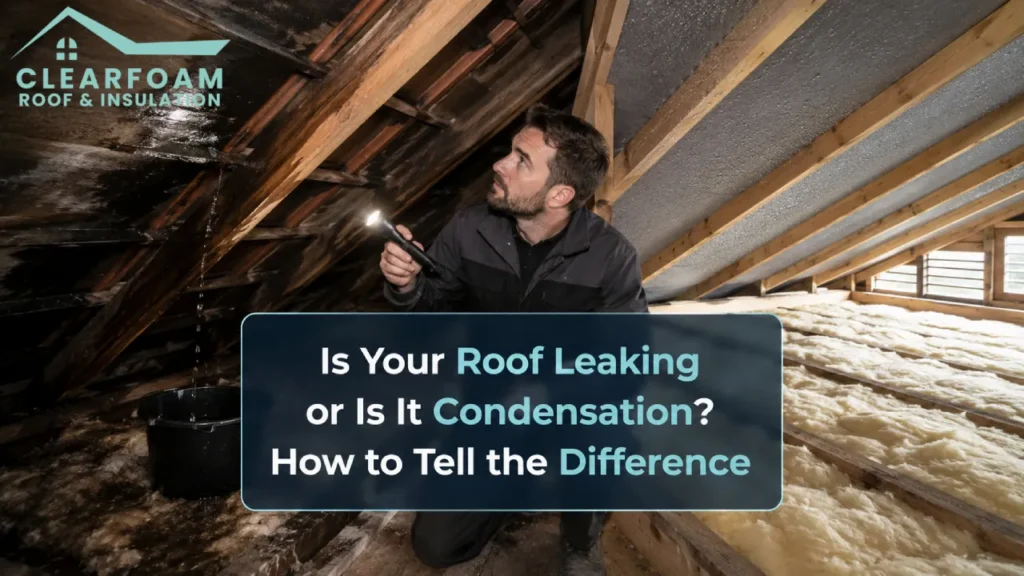
A roof leak is more likely when damp appears during or shortly after rain and follows a localised path from damaged tiles, flashing or another roof detail. Condensation usually forms as fine droplets or widespread moisture across cold roof surfaces, particularly during colder weather.
When comparing roof leak vs condensation, do not rely on one damp patch alone. Water can travel along rafters and roofing membranes before becoming visible, while condensation can sometimes collect heavily enough to drip onto insulation or ceilings. Some homes may also have both problems at the same time.
ClearFoam Roof & Insulation helps homeowners across Bournemouth, Poole, Christchurch and surrounding Dorset assess roofing, ventilation and insulation before deciding what needs to be repaired.
Roof Leak vs Condensation: Compare the Main Clues
The timing, location and pattern of moisture can help indicate the likely cause, although none of these signs provides a final diagnosis by itself.
| What You Notice | More Consistent With a Roof Leak | More Consistent With Condensation |
| Timing | Appears during or after rainfall | Appears mainly during cold weather |
| Moisture Pattern | Localised drip, trail or isolated stain | Fine droplets across a wider area |
| Common Location | Near a chimney, valley, roof window or damaged tile | Underside of felt, membrane, fixings and cold timbers |
| Weather Relationship | Often worsens with wind-driven rain | Often worsens when indoor humidity is high |
| Ceiling Marks | One defined stain or repeated wet patch | Diffuse staining caused by dripping from widespread moisture |
| Likely Source | External water entering the roof | Warm, moist household air meeting cold surfaces |
A stain appearing after rain may suggest water ingress, but plumbing leaks and overflowing gutters can produce similar symptoms. Widespread droplets suggest condensation, although an extensive roof defect can also wet more than one area.
Keep a Short Record of When the Moisture Appears
The timing of the problem often provides a stronger clue than the colour or shape of a ceiling stain.
- During Rainfall: Check whether a fresh drip, dark timber mark or wet section of insulation appears while rain is falling. Note whether the wind is driving rain towards a particular roof slope.
- After the Rain Stops: Some leaks take time to appear because water travels along underlay, battens or rafters before dripping into the loft.
- During Cold, Dry Weather: Droplets forming despite no recent rainfall make condensation more likely. Moisture that appears overnight and reduces as temperatures rise can provide another useful clue.
Take photographs from the same safe position and record the weather conditions. Also note household activities that may have increased indoor humidity, such as bathing, cooking or drying clothes indoors.
Look at Whether the Damp Is Localised or Widespread
One Clear Water Trail
Water running down a single rafter or appearing below a chimney, valley or roof window suggests a particular entry route. The actual defect may sit higher up the roof than the visible stain.
Droplets Across Several Surfaces
Fine beads of moisture covering large sections of roofing felt, membrane, nail heads or timber are more typical of loft condensation. The coldest materials may become wet first.
One Damp Corner Without an Obvious Trail
This pattern can be harder to interpret. Local condensation may develop around a cold bridge, blocked eaves ventilation or a ceiling gap that allows warm air into the loft. A small roof defect or plumbing leak may create a similar result.
Where the pattern appears linked to rainfall or a specific roof component, ClearFoam’s roofing inspection and repair services can help establish whether the external covering is allowing water into the property.
How Does Rainwater Enter a Roof?
External water can enter through a small defect in the roof covering or one of the junctions where materials meet.
Common entry points include:
- Cracked, slipped or missing tiles and slates
- Failed lead flashing around chimneys or wall abutments
- Damaged roof valleys
- Deteriorated seals around roof windows
- Loose ridge, hip or verge components
- Torn roofing felt or membrane details
- Blocked or overflowing gutters
- Damaged roof penetrations
- Wind-driven rain entering an existing weakness
The visible damage may be small even when the internal stain appears substantial. A cracked tile can admit water intermittently, while defective flashing may leak only when rain approaches from a particular direction.
A roof leak may also occur alongside a plumbing fault. Water tanks, pipes and condensate connections inside or near the loft should not be ruled out simply because the moisture appears beneath the roof.
Why Does Condensation Form Inside the Loft?
Condensation forms when warm air containing water vapour reaches a surface cold enough for that vapour to turn into liquid water.
The process usually happens in five stages:
- Moisture is produced inside the home through washing, bathing, cooking, breathing and drying clothes.
- Warm air moves upwards towards the loft.
- Moist air escapes through ceiling gaps, loft hatches, pipe openings or poorly sealed extractor ducts.
- The air reaches cold roofing felt, membrane, fixings or timber.
- Water droplets form and may eventually drip onto the insulation or ceiling.
Blocked soffit vents, insulation pushed tightly into eaves ventilation routes and extractor ducts discharging into the loft can increase the amount of moisture that remains in the roof space.
Homeowners seeing widespread droplets or recurring winter damp can read more about how to stop condensation in the loft without assuming that adding vents alone will solve every moisture problem.
Why Can the Ceiling Stain Be Away from the Defect?
Water does not always fall vertically from the point where it enters the roof.
Rainwater may:
- Run down the underside of a roof tile or slate
- Travel along roofing felt or membrane
- Follow a rafter towards the eaves
- Cross a timber batten
- Collect above the ceiling
- Drip at a joint, nail or low point
For example, failed flashing beside a chimney may allow water into the upper part of the roof. The first visible ceiling mark may appear several metres away because the roof structure has carried the water before it drips.
This is why repairing the area directly above a ceiling stain does not always resolve the problem. Both the internal moisture route and the external roof covering may need inspecting.
What Does Wet Loft Insulation Tell You?
Wet insulation confirms that moisture has reached the loft floor, but it does not identify the source.
A small saturated patch directly beneath a water trail may support the possibility of a leak. Dampness spread across a wider area may be more consistent with condensation dripping from the underside of the roof.
Insulation may also become wet because of:
- A leaking water tank or pipe
- An extractor duct releasing moisture into the loft
- Condensation collecting on roofing felt
- Water entering around a chimney or roof window
- Previous moisture that has not yet dried
Wet insulation should not simply be covered with another layer. The cause must be resolved before the existing material is assessed for drying, removal or replacement.
Can a Roof Leak and Condensation Happen Together?
Yes. A property may have a localised roof defect and a separate ventilation or air-leakage problem.
The Roof Leak:
A slipped tile allows water to run down one rafter during rain.
The Condensation:
Warm bathroom air enters through an unsealed ceiling penetration and creates droplets across another roof slope.
Repairing only the tile would leave the condensation issue unresolved. Improving airflow without repairing the tile would leave continuing water ingress.
This overlap is one reason the roof leak vs condensation decision may require both internal and external inspection rather than relying on one photograph.
What Can You Safely Check Yourself?
Homeowners can make useful observations without climbing onto the roof or disturbing the roof covering.
From a secure loft hatch or properly boarded access area, look for:
- Droplets on roofing felt or membrane
- Water trails along rafters
- Mould spots or darkened timber
- Wet or compressed insulation
- Daylight through an obvious opening
- Moisture around pipes or water tanks
- Extractor ducts ending inside the loft
- Insulation blocking visible eaves ventilation
From ground level, you may be able to see an obviously missing tile, damaged gutter or displaced roof component. Do not climb onto roof tiles, lift slates or walk across exposed ceiling joists.
The absence of visible damage does not prove that the roof is watertight. Many defects are hidden by overlapping materials or can only be seen from a suitable access system.
What Should You Do During Active Dripping?
Move people and belongings away from the affected area where it is safe to do so. A container may help collect water if the ceiling remains stable and no electrical fitting is nearby.
Do not stand underneath a bulging ceiling. Do not touch lights, switches, cables or other electrical equipment affected by water.
Where immediate internal action is needed, ClearFoam’s guide to temporary measures for an internal roof leak explains what short-term steps may help while a lasting repair is arranged.
Severe dripping, a sagging ceiling or moisture near electrical fittings requires prompt professional attention.
Which Professional Should Inspect the Problem?
The appropriate specialist depends on the evidence found.
Roofing Contractor
A roofer can inspect tiles, slates, valleys, flashings, roof windows, gutters, underlay and other weatherproofing details.
Insulation or Ventilation Specialist
This may be appropriate where moisture is widespread and linked to blocked airflow, poor insulation coverage or warm-air leakage.
Plumber
A leaking pipe, water tank or condensate connection can mimic roof water ingress.
Registered Electrician
Electrical advice is necessary where water has reached lighting, wiring, sockets or other electrical components.
Building Surveyor or Structural Engineer
Further assessment may be appropriate where several defects are present, the cause remains uncertain or structural timber condition needs independent investigation.
ClearFoam Roof & Insulation can inspect visible roof components, ventilation routes and insulation before explaining which type of repair or specialist input may be appropriate.
Questions Homeowners Ask About Loft Moisture
What Is the Best Roof Leak vs Condensation Test?
Compare the moisture with rainfall, temperature and the size of the affected area. A localised trail after rain suggests water ingress, while widespread cold-weather droplets suggest condensation.
Does Damp After Rain Always Mean a Roof Leak?
No. Rain can coincide with colder, more humid conditions that increase condensation. Gutters, plumbing and water tanks can also cause moisture during wet weather.
Can Condensation Drip Through a Ceiling?
Yes. Heavy condensation can collect on the underside of the roof and drip onto insulation, eventually causing ceiling stains.
Why Is the Underside of My Roofing Felt Wet?
Widespread droplets may form when warm, moist air meets cold felt. A local water trail beneath one roof detail may indicate external water ingress.
Can Blocked Soffit Vents Cause Condensation?
Restricted ventilation can contribute to moisture build-up in roofs designed to use eaves or soffit airflow. The roof design should be assessed before vents or insulation are altered.
Can Bathroom Steam Enter the Loft?
Yes. Moist air may pass through loft-hatch gaps, ceiling penetrations or extractor ducting that does not discharge outside correctly.
Can a Roof Leak Appear Away from a Broken Tile?
Yes. Water may travel along felt, rafters and battens before becoming visible.
Should Wet Loft Insulation Be Replaced?
It depends on the material, the degree of saturation and how long it has remained wet. The moisture source must be resolved before that decision is made.
Use Reliable Moisture Guidance Before Changing the Roof
Condensation should not be dismissed as harmless. Repeated wetting can affect insulation, decoration and timber condition, while unresolved roof leaks can continue damaging materials outside the visible area.
Before changing ventilation routes, adding insulation or covering damp materials, review the independent NHBC roof-space condensation guidance. It explains how household moisture, air leakage, cold weather and loft ventilation can contribute to condensation beneath a roof.
Identify the Source Before Treating the Stain
A reliable roof leak vs condensation assessment considers timing, rainfall, temperature, moisture distribution and the possible route through the roof. Localised trails appearing after rain may suggest water ingress, while widespread droplets during colder weather are more consistent with condensation. Some properties experience both.
Do not paint over ceiling stains, cover wet insulation or alter roof ventilation until the cause is understood. ClearFoam Roof & Insulation can assess visible roof coverings, structure, insulation and ventilation for homeowners across Bournemouth, Poole, Christchurch and surrounding Dorset.