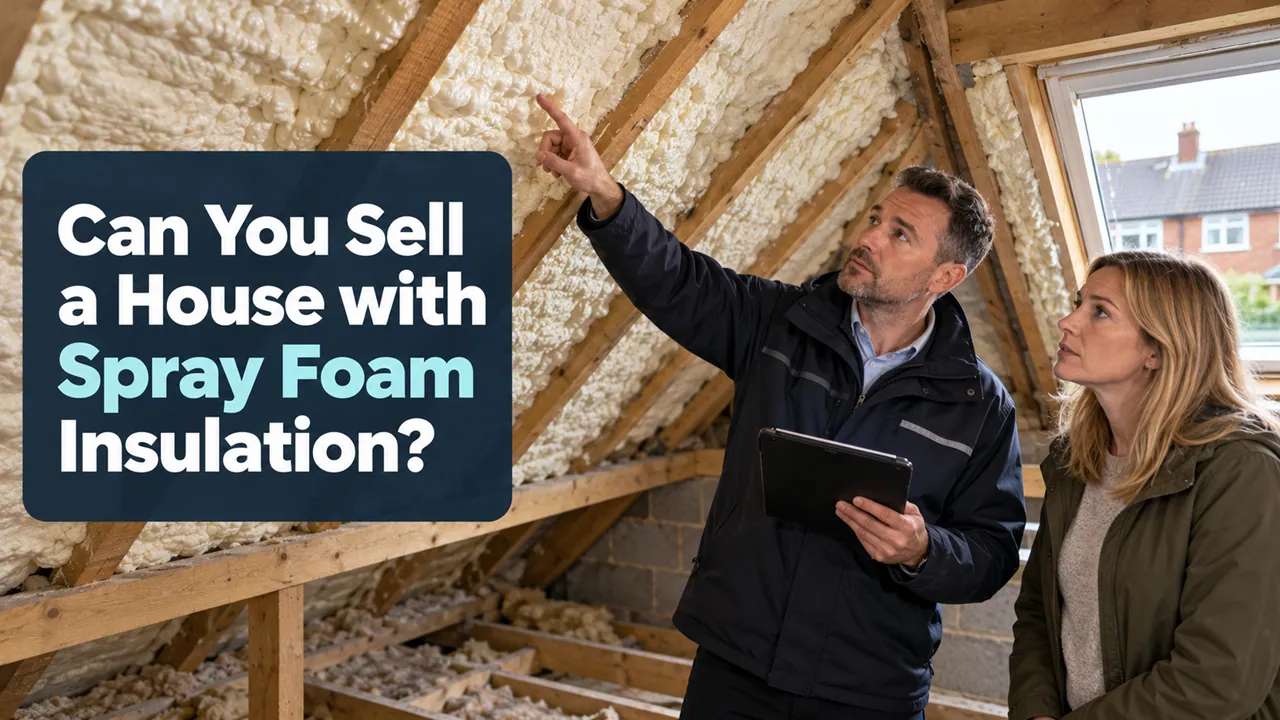
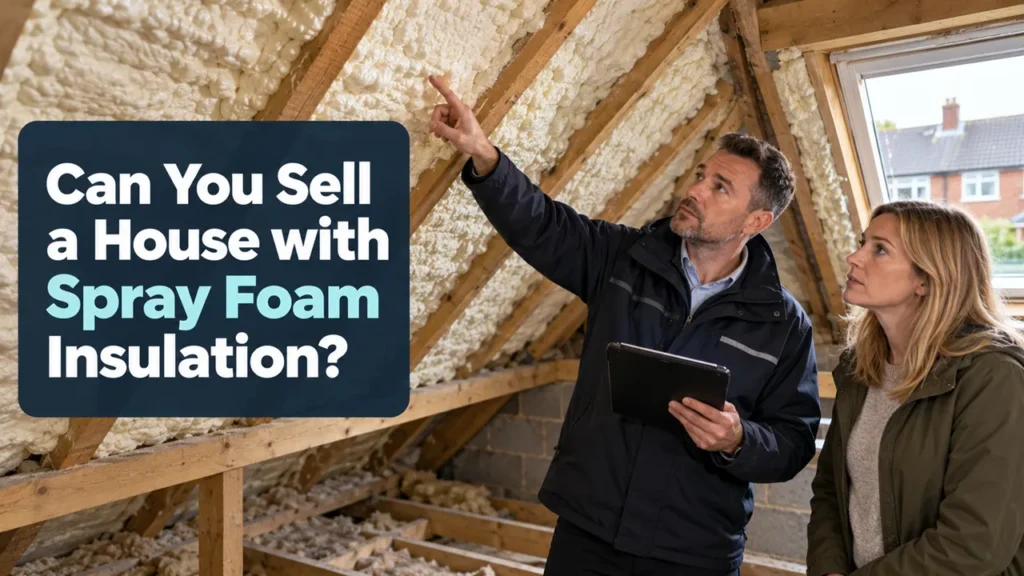
Yes, you can sell a house that has spray foam insulation, but selling a house with spray foam insulation can become more complicated when the buyer needs a mortgage. A surveyor or lender may want more information about the installation, roof condition and visibility of the timbers before the transaction progresses.
Removal is not automatically necessary. Sellers should first establish what was installed, gather the available paperwork, understand the roof’s condition and find out what evidence the buyer or lender actually requires.
What Changes When Selling a House with Spray Foam Insulation?
The presence of spray polyurethane foam does not itself stop you putting your property on the market.
The practical difficulty is that a property sale involves several different parties, and each has a different role. The buyer wants to understand the condition of the house. Their surveyor may need to inspect the roof. A mortgage valuer has to consider the property for lending purposes, while the lender applies its own lending criteria.
Spray foam applied around rafters or the underside of a roof can sometimes restrict the visibility of roof timbers and other components. RICS says the presence of spray foam may affect a surveyor’s professional opinion of value and that an independent specialist report may be requested.
That means the real issue is usually not simply:
“Does the house contain spray foam?”
It is:
“Can the buyer, surveyor and lender obtain enough reliable information about the installation and the roof?”
Before You List the Property, Build a Spray Foam Sale File
One of the most useful things a seller can do is gather the available records before a buyer starts asking for them.
Look for the original installation contract or invoice, installer details, product name, installation date, warranty or guarantee, product specification and any BBA or Kiwa certification supplied with the work.
Roof-related information can be equally important. Keep any photographs taken before or during installation, details of roof repairs, condensation-risk assessments, thermal calculations and previous roof inspection documents.
RICS recommends keeping records and photographs because they may later help demonstrate what was installed and assist when a property is sold or remortgaged. RICS
A certificate should still be treated as evidence rather than a guarantee. Having extensive paperwork does not mean every mortgage lender must accept the property, while missing paperwork does not prove that the roof is defective.
Choose One of Three Positions Before Marketing the House
There is no single correct pre-sale approach. Most sellers are effectively choosing between three positions.
Sell With the Spray Foam in Place
This may be reasonable where there is useful installation documentation, no known roof defect and no current reason to assume removal is necessary.
The advantage is that you avoid carrying out substantial work purely in anticipation of a problem that may not arise.
The limitation is that a buyer’s surveyor or lender could still request further information later.
Assess the Roof Before Deciding
An independent inspection may be useful where the installation history is unclear, timber visibility is restricted or there are questions about moisture, ventilation or the roof covering.
This approach can give the seller more information before deciding whether removal would actually solve a relevant problem.
Remove the Spray Foam Before Selling
Some sellers decide that removal is appropriate before or during a sale, particularly where the buyer’s financing depends on further roof visibility or where the roof itself requires work.
Where removal becomes the appropriate route, ClearFoam Roof & Insulation provides professional spray foam removal for properties in Bournemouth, Poole, Christchurch and surrounding Dorset areas.
Removal should solve a defined problem rather than being presented as a universal requirement for every property containing spray foam.
After an Offer Is Accepted, Expect Two Different Types of Scrutiny
A buyer’s building survey and a mortgage valuation are not the same thing.
A Level 2 Home Survey or Level 3 Building Survey is intended to help the buyer understand the property’s condition within the scope of that inspection.
A mortgage valuation is primarily for the lender. Its purpose is to help the lender decide whether the property provides suitable security for the proposed loan.
Spray foam may therefore appear in both processes for different reasons.
A building surveyor may be concerned about restricted access to rafters, ventilation arrangements, moisture evidence or the inability to inspect parts of the roof.
A mortgage valuer may have to take the lender’s own instructions and policy into account.
This is why one surveyor’s comments should not automatically be interpreted as the final lending decision.
What If the Buyer’s Mortgage Lender Raises Spray Foam?
Ask what evidence is actually required before arranging work.
Mortgage policies are not identical and they can change. The House of Commons Library’s January 2026 briefing confirms that some lenders consider spray-foam properties according to individual criteria, while homeowners can experience difficulties where a lender or valuer is not satisfied with the available evidence.
The lender might want further survey information, documentation about the installation or evidence concerning the roof condition.
Where lender policy itself is the issue, refer to ClearFoam’s dedicated guide to mortgage lenders and spray foam insulation rather than treating one lender’s position as representative of the whole mortgage market.
The seller should also avoid commissioning expensive work based solely on what another homeowner says their lender required.
Should You Remove Spray Foam Before Selling?
Not automatically. The decision should follow the condition of the roof, the available evidence and the requirements arising in the actual transaction.
| Situation | What It May Mean for the Seller |
| Good installation records and no known roof issue | Selling with the foam in place may remain an option |
| Installation paperwork is missing | Further assessment may help answer questions |
| Surveyor cannot inspect enough of the roof | Additional access, investigation or removal may be considered |
| Moisture or roof defects are suspected | Roof condition needs investigating separately |
| Buyer’s lender asks for specific remedial work | Clarify the requirement before commissioning work |
| Foam removal is recommended | Assess what condition is revealed underneath |
| Roof already requires major work | Removal may form part of a wider roofing project |
This is guidance rather than a prediction of how a particular sale will proceed.
The House of Commons Library notes that current industry guidance does not treat removal as necessary in every situation and recommends property-specific professional assessment where remedial action is being considered.
Does Open-Cell or Closed-Cell Foam Decide Whether the House Can Be Sold?
No. Foam type is relevant, but it should not be used as a shortcut to deciding whether a property is saleable.
Open-cell and closed-cell spray foams have different physical characteristics, but the property transaction also depends on where the material has been applied, its installation, roof construction, ventilation, visible timber condition and available supporting evidence.
For example, knowing that the insulation is open-cell does not automatically guarantee lender acceptance.
Equally, identifying closed-cell foam does not prove that a complete roof replacement will be required.
For selling a house with spray foam insulation, the complete roof build-up matters more than applying a simple acceptable or unacceptable label to the foam.
What If Removal Exposes a Roof Problem?
This is one reason sellers should avoid assuming the cost and scope of the project before the insulation is removed.
As foam is taken away, previously concealed areas of rafters, underlay, battens or other components may become visible. The outcome could range from a serviceable roof requiring no significant additional work to localised repairs or more substantial roofing work.
A full roof replacement should not automatically be assumed.
ClearFoam’s guide to when spray foam can be removed without a full roof replacement explains why the condition exposed during removal should determine the extent of subsequent roofing work.
That distinction can be particularly important during a sale because the seller needs evidence of the actual roof condition, not assumptions made before access was available.
Keep Evidence if Spray Foam Is Removed
If removal takes place, build a new record of the work rather than discarding the previous paperwork.
Useful evidence can include photographs before removal, photographs showing the work in progress, images of accessible exposed roof components and details of any subsequent roof or timber repairs.
Retain the contractor’s completion paperwork and any independent inspection arranged afterwards.
These documents serve different purposes.
A removal contractor can document what work was completed. An independent surveyor may provide a separate opinion about the property or roof. Neither document should automatically be described as guaranteeing mortgage approval.
That separation is important because the ultimate lending decision belongs to the mortgage lender.
How Should Spray Foam Be Handled During Conveyancing?
Do not wait for exchange of contracts before asking how the installation should be dealt with in the legal paperwork.
The current Law Society TA6 Property Information Form is the 6th edition introduced in 2025. Its explanatory guidance tells sellers to discuss questions they are unsure about with their solicitor rather than treating the notes as personalised legal advice.
There is no reason to invent a special “spray foam question” if the current form does not contain one.
Instead, answer relevant property-information questions accurately according to your knowledge and give your conveyancer the installation, guarantee, survey and remedial-work documents you hold. Your solicitor or conveyancer can advise how the work should be dealt with in your particular transaction.
ClearFoam Roof & Insulation does not replace that legal advice.
Would Selling to a Cash Buyer Remove the Problem?
A cash buyer removes the mortgage-lender stage, but not the property-condition question.
A cash purchaser may still commission a building survey, ask for installation paperwork, investigate the roof or change their offer after considering the information available.
Selling for cash should therefore not be presented as an automatic solution to spray foam.
It simply changes one element of the transaction because there is no mortgage lender assessing the property as security for a loan.
What Should Sellers Avoid Doing?
The most expensive mistake can be reacting before establishing what the transaction actually needs.
Avoid commissioning immediate removal solely because you have heard that all lenders reject spray foam. Do not assume an installation guarantee will automatically satisfy the buyer’s lender either.
The same caution applies after removal. A contractor’s completion document can provide useful evidence, but it should not be marketed as universal mortgage approval.
Sellers should also be careful about claims that removal will automatically restore a particular property value. Valuation depends on the property, its condition and the professional judgement of the valuer.
Questions Sellers Commonly Ask
Can You Sell a House with Spray Foam Insulation?
Yes. The presence of spray foam does not automatically prevent a property being sold, although surveys, roof visibility and mortgage requirements can make the transaction more complicated.
Does Selling a House with Spray Foam Insulation Require Removal?
No. Removal may be appropriate in some circumstances, but it is not an automatic requirement for every property.
Is It Legal to Sell a House with Spray Foam?
The practical issue is normally not a blanket prohibition on selling the property. Sellers should provide accurate property information and ask their conveyancer how the installation and available documentation should be handled in the transaction.
Can a Buyer Get a Mortgage on a Property with Spray Foam?
Sometimes, but lender criteria vary. The buyer or mortgage broker should confirm the current lender requirements for that particular application.
Why Might a Surveyor Flag Spray Foam?
Spray foam can restrict visibility of roof timbers and other components, and the surveyor may need more information about the installation, moisture conditions or roof construction before giving a fuller opinion.
Should I Remove Spray Foam Before Putting My House on the Market?
Not necessarily. It can be useful first to gather the installation documents, understand the roof condition and consider whether there is a genuine reason for removal.
Does Spray Foam Removal Guarantee That a Buyer Will Get a Mortgage?
No. Removal can address particular roof or inspection issues, but the lender makes its own mortgage decision.
Will Removing Spray Foam Mean I Need a New Roof?
Not automatically. The need for roofing repairs or replacement depends on what condition is found as the insulation is removed.
Check Independent Guidance Before Making a Sale Decision
Sellers considering removal, further inspection or additional documentation can consult the RICS consumer guidance on spray foam insulation for independent UK guidance on roof condition, record keeping, surveys and property transactions.
Using independent guidance is particularly useful before committing to substantial remedial work because selling a house with spray foam insulation involves several separate questions: the physical condition of the roof, the evidence available to the surveyor and the requirements of any mortgage lender involved.
Prepare the Evidence Before the Sale Reaches a Deadline
The best approach to selling a house with spray foam insulation is to deal with uncertainty before it becomes a last-minute obstacle.
Gather the installation paperwork, understand what can and cannot be inspected, keep records of the roof condition and ask for clarification whenever a surveyor or lender requests further evidence. Removal should then be considered because it addresses a genuine roof, inspection or transaction requirement, not because every spray-foam property is assumed to need the same solution.
ClearFoam Roof & Insulation provides spray foam assessment and removal support for homeowners in Bournemouth, Poole, Christchurch and surrounding Dorset areas. Where removal is being considered before or during a sale, the scope of work should follow the individual roof and the evidence actually required, without promising a particular mortgage, valuation or sale outcome.