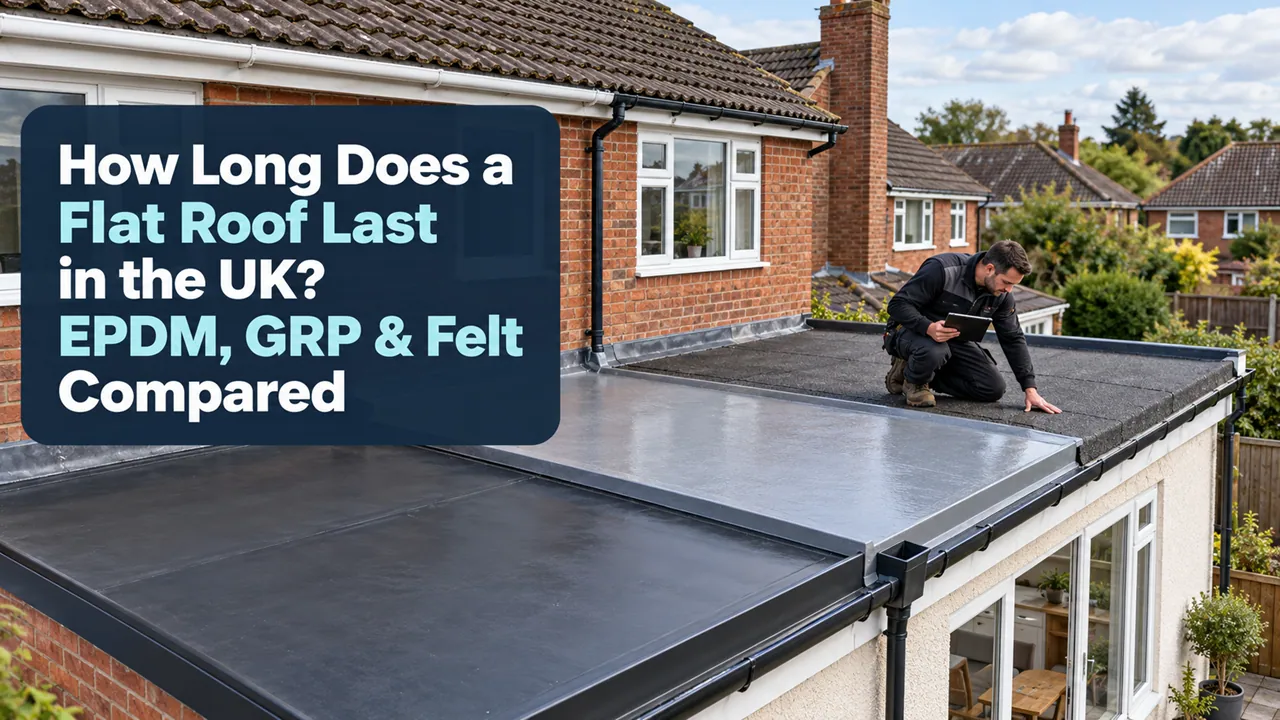
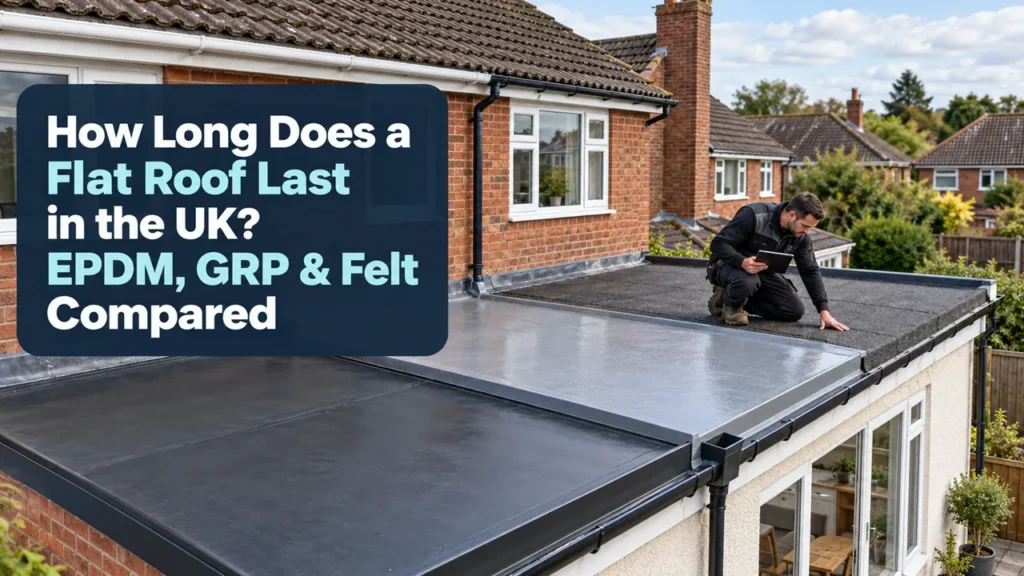
How long does a flat roof last? There is no reliable expiry date that applies to every roof. Current technical evidence shows that specific modern flat-roof systems can have expected service lives of 25 years, 30 years or even more than 50 years, depending on the material and system.
The real lifespan depends on far more than whether the surface is labelled EPDM, GRP or felt. The roof deck, installation quality, joints, drainage, detailing, exposure and maintenance all affect how long the complete roof remains serviceable.
Age is therefore useful context, but it should not be the sole reason for replacing a flat roof.
Flat Roof Lifespan Is Better Measured by System Than Material Name
A homeowner might be told that felt lasts one length of time, GRP another and EPDM another. Those figures are useful only as broad guidance.
Within each category there are different products, specifications and installation methods. A professionally specified reinforced bituminous membrane is not equivalent to basic shed felt. One EPDM system may differ from another in membrane thickness, seams, adhesives and detailing. GRP performance also depends heavily on the roof deck and how the resin system was installed.
A more accurate relationship is:
roofing material + system specification + installation + roof design + maintenance = actual service life
That explains why two flat roofs installed in the same year can reach very different conditions later.
How Long Can an EPDM Flat Roof Last?
EPDM is capable of a long service life, but published figures should be attached to the actual membrane system rather than applied to every rubber roof.
Elevate currently states that its RubberCover EPDM membrane has a life expectancy of more than 50 years. It also identifies membrane thickness and correct system installation as relevant parts of the roofing specification.
EPDM remains flexible, which helps it accommodate normal thermal movement. On domestic roofs, however, the membrane itself is only part of the system.
The condition of perimeter details, roof penetrations, adhesive bonds and any seams can become more significant than the centre of the sheet.
A 30-year-old EPDM roof with sound detailing may therefore remain useful, while a much younger installation with poor edge bonding or an unsuitable deck can require attention far earlier.
How Long Can a GRP Fibreglass Roof Last?
For GRP, or glass-reinforced plastic, current third-party evidence supports service lives measured in decades.
Polyroof’s 185 GRP system has BBA certification with a certified lifespan of at least 25 years. The manufacturer specifies its use over an approved OSB3 or plywood deck, which illustrates how closely GRP performance is connected to the substrate beneath it.
GRP cures into a rigid waterproof surface rather than remaining flexible like EPDM.
That makes the condition and stability of the roof deck especially relevant. Movement beneath the laminate, unsuitable installation conditions or weaknesses around details can contribute to cracking even if the GRP material itself has not simply become “too old”.
A GRP roof should therefore be judged by both surface condition and what is happening beneath it.
How Long Does Modern Felt Roofing Last?
There is no meaningful single lifespan for all felt roofs because the term covers very different products.
Basic mineral shed felt, self-adhesive coverings and professional reinforced torch-applied systems should not be grouped together.
As an example of modern high-performance bituminous waterproofing, a current BBA certificate for an Icopal system states that the product can have a service life in excess of 30 years under normal conditions of exposure and use.
That does not mean every felt roof should be expected to last 30 years.
It does show why the old assumption that “felt only lasts around ten years” is too simplistic for current professional flat-roof systems.
The useful questions are what type of felt was installed, how many layers form the system, what condition the laps and surface are in, and whether the roof underneath remains sound.
A 15-Year-Old Roof Can Be in Better Condition Than a 7-Year-Old Roof
Calendar age tells you how long a covering has existed. It does not tell you how effectively it has performed during that period.
Several factors can move a roof towards either end of its expected lifespan.
Installation Quality
Good materials cannot compensate indefinitely for poor workmanship.
Incorrect bonding, poorly formed laps, weak edge details, inadequate treatment around outlets or badly prepared substrates can create premature problems.
The reverse is also true. A correctly installed system gives the material a much better opportunity to achieve its intended service life.
Roof Deck Condition
The waterproof covering depends on the substrate beneath it.
If timber decking softens, deflects or deteriorates, the surface above can move or lose support. This can contribute to cracking, low spots and problems at joints.
Replacing only the visible covering without addressing a damaged deck does not restore the complete roof.
Detailing
Upstands, wall junctions, rooflights, outlets, edges and penetrations create transitions in the waterproofing.
A flat roof can remain sound across most of its surface while developing a local issue at one of these details.
This is why one leak does not automatically prove that the whole membrane has reached the end of its life.
Drainage
Water needs an effective route away from an ordinary domestic flat roof.
Blocked outlets, poor falls or local dips can leave water sitting in particular areas. Persistent ponding should be investigated in relation to the roof system rather than automatically treated as proof that replacement is necessary.
ClearFoam has a separate guide explaining water pooling on a flat roof, including why falls, low spots and drainage restrictions need to be assessed separately from membrane age.
Warranty Length Is Not the Same as Flat Roof Life Expectancy
This distinction matters because homeowners frequently use the warranty period as though it were the roof’s expiry date.
A 20-year guarantee does not mean:
the roof is guaranteed to fail after 20 years.
It also does not necessarily mean:
every type of defect that occurs within those 20 years is automatically covered.
A guarantee normally applies to particular products, installation conditions or specified defects and has its own terms.
BMI Icopal, for example, currently offers different types of guarantee with durations between 10 and 35 years depending on the products and guarantee level, while separately discussing product service life and ongoing maintenance requirements.
This difference also reflects a concern raised repeatedly in homeowner discussions. A long written guarantee is useful, but poor workmanship can still cause problems much earlier, so the quality of the roof itself remains central.
How Does Each Flat-Roof Material Usually Show Its Age?
Different waterproofing systems tend to raise different inspection questions as they age.
EPDM Ageing
An EPDM assessment may focus on punctures, lifting edges, local shrinkage, seams where present, adhesive performance and details around penetrations.
A local defect does not necessarily mean that the main membrane has deteriorated.
The pattern matters. One repairable detail is different from widespread loss of adhesion or deterioration across several parts of the roof.
GRP Ageing
With GRP, cracking, crazing, deterioration of the topcoat or movement-related defects deserve attention.
Where cracking repeatedly follows deck joints or areas of movement, the cause may involve more than the visible laminate.
An inspection should therefore consider the relationship between the GRP and the substrate.
Felt Ageing
Ageing felt can show splitting, blistering, lifting laps, local cracking or deterioration of the exposed surface.
The extent is more useful than the existence of one mark.
One isolated repairable split on an otherwise sound system presents a different decision from cracking, blistering and failed laps appearing across much of the roof.
When Does Roof Age Start to Support Replacement?
Age becomes more useful when it is combined with condition.
| What You Find | What It Suggests | Likely Direction |
| Older roof, sound surface, no known ingress | Age alone does not prove failure | Continue condition-based maintenance |
| One isolated defect | Local failure may be present | Repair may be proportionate |
| Several unrelated repair areas | Wider deterioration may be developing | Assess remaining service life |
| Repeated leaks after previous repairs | Existing covering may be losing reliability | Compare repair with renewal |
| Widespread splitting, cracking or delamination | System deterioration may be extensive | Replacement becomes more relevant |
| Soft or moisture-damaged roof deck | Problem extends beneath the covering | Roof build-up needs assessment |
| Failed edges, outlets and surface covering together | Several elements are deteriorating | Wider refurbishment may be justified |
This is why an older roof should not automatically be condemned, while a younger roof should not automatically be assumed sound.
Where defects are no longer isolated, ClearFoam’s guide to roof repair versus replacement explains how the extent of deterioration changes the decision.
Can Maintenance Actually Make a Flat Roof Last Longer?
Maintenance cannot turn a defective installation into a durable one, but it can reduce avoidable deterioration and help identify small problems earlier.
A sensible approach is:
- Keep accessible rainwater outlets and drainage routes free from debris.
- Watch for changes such as lifting details, cracking, blistering or new standing water.
- Have damage assessed before repeated temporary patches become the only maintenance strategy.
- Keep records of repairs where possible so recurring defects can be identified.
- Follow the maintenance requirements of the particular roofing-system manufacturer.
Homeowners should not climb onto a wet, deteriorated or potentially fragile flat roof simply to inspect it.
Visual checks from a safe location can identify obvious changes, while closer roof-surface and deck assessments should use appropriate access.
Which Lasts Longer, EPDM, GRP or Felt?
Based on the technical systems reviewed for this article, EPDM has some of the longest published service-life evidence, including a named membrane with a stated life expectancy beyond 50 years.
That does not make EPDM automatically better for every property.
GRP can provide decades of service and offers characteristics that suit particular roof shapes and uses. Modern reinforced bituminous systems can also achieve far longer service lives than low-grade felt products.
The better comparison is not:
EPDM versus GRP versus felt in isolation.
It is:
a correctly specified EPDM system versus a correctly specified GRP system versus a correctly specified reinforced bituminous system for the particular roof.
The roof shape, deck, detailing, intended use and contractor’s familiarity with the selected system can all influence the outcome.
When Is a Professional Flat-Roof Inspection Worthwhile?
A professional inspection becomes more useful when you cannot answer the lifespan question from age and maintenance records alone.
Repeated leakage, widespread surface deterioration, new soft areas, cracking, failed joints, persistent drainage changes or uncertainty about the deck underneath are all reasonable triggers for closer assessment.
ClearFoam Roof & Insulation provides professional roofing services across Bournemouth, Poole, Christchurch and surrounding areas.
For an ageing flat roof, an assessment can consider the membrane or felt, edges, joints, drainage, roof deck, previous repairs and visible signs of water ingress before repair or replacement is recommended.
Flat Roof Lifespan FAQs Based on Current Search Intent
The questions below were selected from recurring current search-result patterns and practical issues repeatedly raised by UK homeowners in roofing discussions, particularly around lifespan, replacement timing, workmanship and guarantees.
How Long Does a Flat Roof Last in the UK?
A professionally specified flat roof can remain serviceable for decades. The correct figure depends on the system rather than roof shape alone, with current technical evidence for specific GRP, reinforced bitumen and EPDM products ranging from 25 years to more than 50 years.
Can a Flat Roof Last 30 Years?
Yes. Current BBA and manufacturer documentation supports service lives of 30 years or more for some modern roofing systems.
Reaching 30 years does not mean the roof is automatically due for replacement. Its present condition still needs to be considered.
Which Lasts Longer, EPDM or GRP?
Some EPDM products have longer published life-expectancy figures than the GRP systems reviewed here. However, installation, detailing and deck condition can matter more than the headline material comparison on an individual property.
How Do I Know if My Flat Roof Needs Replacing or Just Repairing?
Look at whether the defect is isolated or widespread.
One damaged detail may be repairable. Repeated leaks, deterioration across several areas, a damaged deck or multiple failing previous repairs make a wider replacement assessment more appropriate.
Does a 20-Year Guarantee Mean My Roof Will Last 20 Years?
Not necessarily. A guarantee describes defined cover for a stated period, while expected service life describes how long the roofing system may remain functional.
A roof may remain serviceable after the guarantee expires, while defects excluded from the guarantee could occur earlier.
Does Ponding Water Shorten a Flat Roof’s Life?
Persistent unwanted ponding can expose roof details and waterproofing to prolonged wet conditions, but it does not automatically mean the covering has failed.
The reason for the standing water and the requirements of the particular roofing system should be checked.
How Often Should a Flat Roof Be Inspected?
There is no sensible single inspection interval for every domestic roof. Manufacturer requirements, roof age, surrounding debris, previous problems and access all matter.
Some commercial flat-roof manufacturers require regular recorded maintenance, and an ageing roof with previous defects may justify more frequent checking than a newer system with no known problems.
Check Current UK Flat-Roof Guidance Rather Than Using an Expiry Date
Flat-roof design guidance continues to reinforce the idea that the waterproof covering is only one part of a successful roof.
The 2025 revision of BS 6229 strengthened requirements covering roof falls, workmanship, maintenance and other aspects of continuously supported flat roofs. NFRC has published a current summary of these changes for the UK roofing industry.
For further technical context, see the NFRC guidance on BS 6229:2025.
The practical takeaway for an existing homeowner is that service life depends on the complete roof build-up and its current condition, not merely the brand or age of the visible waterproof layer.
Treat Flat-Roof Lifespan as a Condition Question, not a Countdown
The strongest answer to how long does a flat roof last is that modern systems can remain serviceable for decades, but there is no universal replacement year.
Current evidence supports more than 50 years for a specific EPDM membrane, at least 25 years for a certified GRP system and more than 30 years for certain reinforced bituminous waterproofing systems. Those figures demonstrate what properly specified systems can achieve, not what every roof will achieve.
An ageing roof should therefore be judged through material + specification + installation + deck + drainage + detailing + present condition.
ClearFoam Roof & Insulation can assess ageing flat roofs across Bournemouth, Poole, Christchurch and surrounding Dorset where homeowners are unsure how much service life remains. If inspection shows that renewal is becoming the appropriate option, the separate guide to how long reroofing takes covers the project-timing question without confusing it with the lifespan decision.