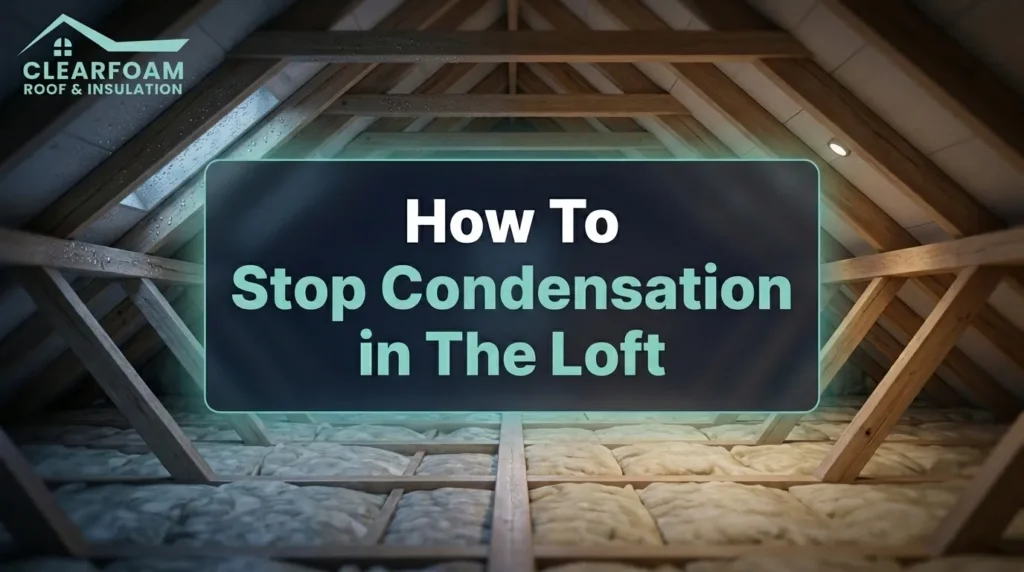
If you’ve climbed through the loft hatch on a cold morning and seen droplets clinging to the underside of the felt, you’ve got a condensation problem. Knowing how to stop condensation in the loft comes down to three things, done in the right order: fix airflow first, cut the moisture rising from below second, and reposition insulation third. Done properly, most lofts dry out within a few weeks.
How To Stop Condensation in The Loft in Three Actions
Loft condensation happens when warm, moist air from the house rises into a cold loft and meets cold surfaces (the felt, the underside of slates, the timber rafters). The water vapour cools, condenses, and forms droplets. The fix is three steps:
- Restore airflow at the eaves and ridge. Check soffit vents aren’t blocked and add ridge or tile vents if the roof has no exit point. Building Regulations Approved Document F sets the minimum ventilation rates for cold roofs.
- Stop moist air rising from the rooms below. Seal the loft hatch with draught strip, never vent a bathroom or kitchen extractor into the loft itself, and add covers over recessed downlighters.
- Lift insulation back from the eaves. Insulation pushed tight to the wall plate blocks soffit airflow. Leave a 50mm clear gap or fit eaves ventilation trays.
If you’re working out how to stop condensation in the loft yourself, those three steps cover the majority of cases.
Why Does My Loft Have Condensation in the First Place?
Three things have to be present together: warm moist air, a cold surface, and a route for the air to reach that surface. Take any one out and the condensation stops.
Most of the moist air comes from inside the house. Cooking, showering, breathing, drying clothes indoors, and unvented fans all push water vapour into the air. That air rises through gaps around the loft hatch, downlighters, and pipework penetrations. Once it hits the cold loft (especially between November and March in Dorset), it dumps its moisture wherever it lands.
Coastal Bournemouth, Poole, and Christchurch sit in one of the more humid pockets of the UK. The marine layer keeps background moisture higher than inland counties, so lofts here are slightly more prone to winter condensation than average.
Worried About Condensation in Your Loft in Bournemouth or Poole?
Find out more about ClearFoam Roof & Insulation and how we work. We assess ventilation, insulation positioning, and moisture sources, then write up the fixes needed to bring the loft back to a healthy state. No spray foam upsell, since we don’t install it.
Signs Your Loft Condensation Has Turned into A Real Problem
If you spot any of these, knowing how to stop condensation in the loft moves from a weekend job to a priority:
- Black speckled mould on the underside of the felt or along the rafters.
- A damp, musty smell when you lift the loft hatch.
- Water droplets visible on the underside of slates, tiles, or nail tips poking through the felt.
- Loft insulation that looks darker than original or feels damp to the touch.
- Damp patches showing up on upstairs ceilings, particularly near external walls.
- Rust spots on metal water tanks, pipework, or galvanised straps.
Any two of these together and the loft needs a survey, not just a dehumidifier.
How To Stop Condensation in The Loft When Spray Foam Insulation Is Involved
Spray foam adds a complication mineral wool and fibreglass don’t. The RICS consumer guide on spray foam flags it as a leading cause of condensation and timber decay when retro-fitted to existing roofs. There are two foam types, and each behaves differently.
Open-Cell Spray Foam and Trapped Moisture
Open-cell foam is porous. It absorbs water vapour rising from the house rather than blocking it, then holds that moisture against the roof timbers. Over a few winters, you get soft, damp rafters under foam that looks dry from the inside.
Closed-Cell Spray Foam and Warm Roof Conversion
Closed-cell foam is rigid and acts as a vapour barrier when applied thickly. The problem is that it bonds directly to the felt and timbers. Any moisture that does get through, from a small leak or a vapour gap, is held against the wood with no airflow to dry it out. We’ve pulled closed-cell foam off rafters in Christchurch that were soft to the touch underneath.
The fix in both cases isn’t more vents around the foam. It’s removal, restored ventilation, and reinsulation with breathable mineral wool laid at ceiling level (the build-up UK roofs were designed for).
Worried Your Spray Foam Has Caused a Loft Moisture Problem?
If your roof was sprayed in the past decade and you’re now seeing condensation, dark patches on timbers, or a mortgage valuer has flagged the foam, our spray foam removal service covers the South of England. The survey is free and we explain exactly what’s behind the foam before any work starts.
Does Loft Insulation Cause Condensation by Itself?
Not directly, but it can make existing condensation worse if it’s positioned badly. When working out how to stop condensation in the loft, position matters as much as material.
The two recurring mistakes:
- Insulation pushed tight against the eaves, blocking soffit airflow.
- Insulation pulled up the underside of the rafters with no vapour control layer and no breather membrane upgrade, leaving timber sandwiched between cold air and damp insulation.
Mineral wool at 270mm depth, laid between and over joists, is the current Building Regulations recommendation. Installed correctly with eaves clearance, it’s part of the fix, not the cause.
Mistakes That Make Loft Condensation Worse, Not Better
Knowing how to stop condensation in the loft is partly about what not to do. The most common errors we see across Dorset:
- Venting a bathroom or kitchen extractor into the loft itself instead of through a soffit or tile vent to outside. This is the single biggest cause we find.
- Sealing the loft hatch but ignoring the dozen downlighter holes in the ceiling below, which leak warm moist air the whole time.
- Drying laundry on an airer in an upstairs bedroom with the door closed.
- Adding a dehumidifier as the only fix without addressing the ventilation underneath.
- Painting the underside of the felt with an anti-condensation coating, which rarely lasts a winter and masks the real cause.
What We Check on A Loft Condensation Survey Across Bournemouth and Poole
Every loft condensation survey at ClearFoam Roof & Insulation starts with the same order: soffit ventilation first, ridge ventilation second, loft hatch and downlighters third, then any extractor ducting that runs through the space. We use a thermo-hygrometer to log temperature and humidity at joist level and a moisture meter on the rafters.
On a job in Branksome last January, a homeowner had been wiping down rafters every weekend for three months. The cause turned out to be a bathroom extractor duct that had come loose in the loft, pumping shower steam straight onto the felt. Reconnecting the duct and venting it properly through a soffit vent fixed the condensation in two weeks.
For pitched-roof ventilation rates we work to BS 5250, the British Standard for moisture management in buildings, alongside Approved Document F. The standard accounts for UK winter conditions and provides the technical basis behind the regulations.
When To Call a Professional for Loft Condensation in Dorset
If you’ve sealed the hatch, cleared the eaves, and the droplets keep coming back, it’s time for a survey. Same if there’s black mould across more than a small patch of timber, water dripping onto stored items, or signs the felt is staining or sagging.
Knowing how to stop condensation in the loft yourself works for mild cases. For anything past that, particularly where spray foam is involved or the timbers are starting to soften, a survey is faster and cheaper than guessing.
Frequently Asked Questions
How To Stop Condensation in The Loft in Winter Specifically?
Improve airflow at the soffits and ridge, seal the loft hatch and downlighters, and reduce moisture-producing activities (drying laundry indoors, unvented showers). Winter is when condensation peaks because the temperature gap between the warm house and cold loft is largest.
Does Loft Insulation Cause Condensation?
Not on its own. Loft insulation only contributes when it blocks airflow at the eaves or is positioned in a way that creates cold spots. Properly laid mineral wool with eaves clearance is part of the solution.
Will A Dehumidifier Stop Loft Condensation?
A dehumidifier helps with symptoms but doesn’t fix the cause. If ventilation is poor or moist air keeps rising from the house, the unit will run constantly and condensation returns the moment it’s switched off.
Is Condensation in the Loft After Insulation Normal?
Some short-term moisture is common in the first winter after major insulation work, especially if airflow at the eaves was reduced. Persistent condensation after the first heating season points to a ventilation or vapour-leak problem that needs investigating.
How To Stop Condensation in the Loft When Spray Foam Has Been Installed?
The honest answer is removal. Spray foam applied to a roof originally built as a cold-ventilated structure traps moisture against the timbers. ClearFoam Roof & Insulation handles this across Bournemouth, Poole, Christchurch, and the wider South.
Book A Free Loft Condensation Survey with Clearfoam Roof & Insulation
Got water dripping from the felt, black mould on the rafters, or a damp smell every time you open the loft hatch? Get in touch with us and we’ll arrange a free survey across Poole, Christchurch, Ferndown, Wimborne, and the wider Dorset and Hampshire area. We’ll explain how to stop condensation in the loft on your specific roof type and give you a clear quote before any work starts.