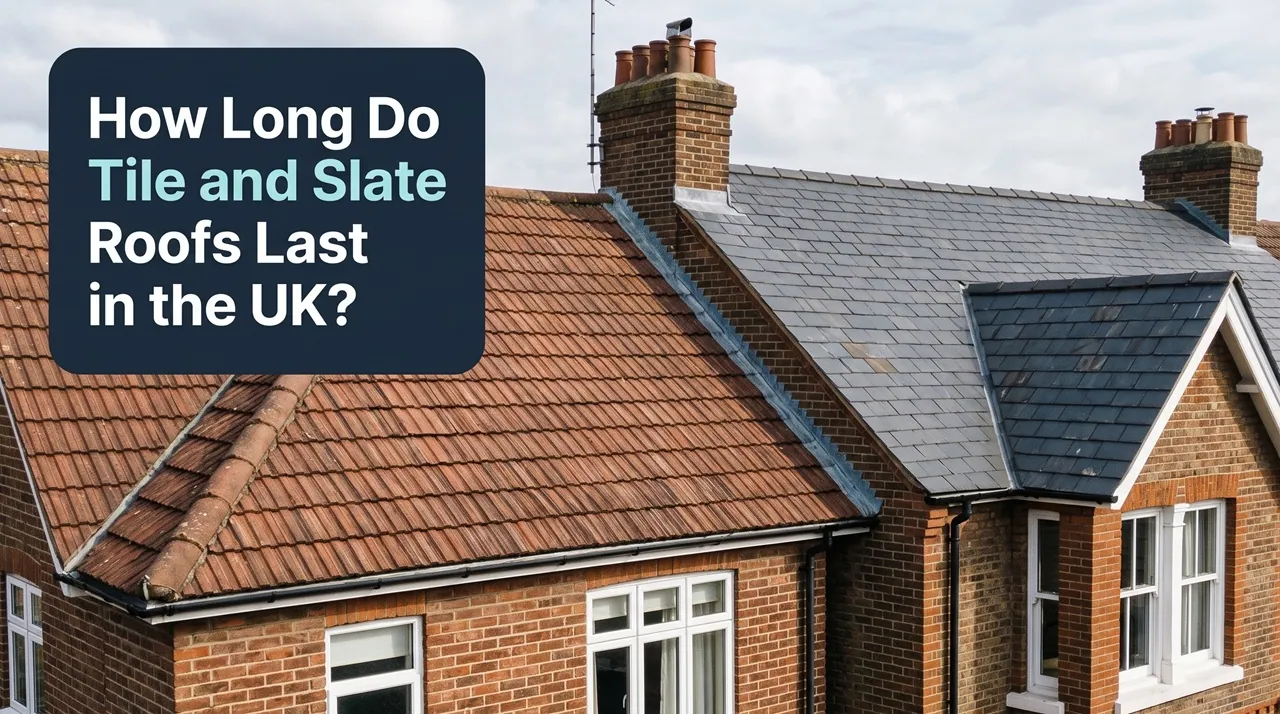
Most UK pitched roofs are covered with concrete tiles, clay tiles or natural slate, and each material ages at a different rate. How long do roof tiles last depends first on what the covering is made of. Concrete tiles commonly remain serviceable for around 40 to 60 years, clay tiles often last considerably longer, and sound natural slate can outlast both. All figures here are expected service lives for a correctly installed roof, not guarantees.
One distinction matters more than any single figure: the lifespan of the covering is not the lifespan of the complete roof system. Tiles or slates can still be sound while the fixings, battens, underlay or flashing underneath them are reaching the end of their life. This guide covers pitched tile and slate roofs only, because flat roof systems age differently and are covered in the separate flat roof lifespan guide.
Tile and Slate Lifespans at a Glance
The table below summarises typical service life for each covering, and what usually needs attention first.
| Roof covering | Typical expected service life | What often needs attention first |
| Concrete roof tiles | Around 40 to 60 years | Surface weathering and ridge or verge details |
| Clay roof tiles | Around 60 to 100 years, sometimes longer | Individual cracked or frost damaged tiles |
| Natural slate | Around 80 to 100 years or more | Fixings, particularly older iron nails |
| Fibre cement slate | Around 30 to 50 years | Fixings and surface weathering |
Treat the ranges as a starting point, not a prediction. Two roofs of the same age and material can be in very different condition.
How Long Do Concrete Roof Tiles Last?
Concrete is the most common covering on modern UK homes, so it is usually where the question of how long do roof tiles last begins. Concrete interlocking tiles and concrete plain tiles typically remain serviceable for around 40 to 60 years. Manufacturer expectations can sit higher: Marley states that its concrete tiles are generally expected to last 60 years or more, as set out in the Marley concrete tile guide.
Concrete tiles age gradually rather than suddenly. The surface coating fades, the tile face slowly erodes and older tiles become more porous and brittle. Fading on its own is cosmetic and does not mean the tiles have failed. A concrete roof is nearer the end of its useful life when cracking and slipped tiles appear across the roof rather than in one spot.
How Long Do Clay Roof Tiles Last?
Clay tiles usually outlast concrete tiles. A clay tiled roof commonly lasts around 60 to 100 years, and well made clay plain tiles on a sheltered roof can remain serviceable for longer than that. Fired clay is stable and holds its colour well.
Clay’s main weaknesses are frost damage and impact. Poorer quality or very exposed tiles can crack or spall, where the face of the tile flakes away after repeated freezing and thawing of absorbed moisture. A clay roof rarely fails all at once. Individual tiles deteriorate at different rates, so localised replacement can keep a sound clay roof working for many years.
How Long Does a Slate Roof Last?
Slate is the covering that most often changes the answer to how long do roof tiles last, because natural slate is a quarried stone rather than a manufactured product. How long a slate roof lasts depends heavily on the quality and origin of the slate.
Natural Slate
Sound natural slate typically remains serviceable for around 80 to 100 years or more. It absorbs very little water and does not rot. On many older roofs the slates remain usable long after the original fixings have corroded.
Welsh Slate and Imported Slate
Welsh slate is widely regarded as the most durable roofing slate and can remain serviceable for over 100 years. Spanish and other imported slates vary much more with quarry and grade, and poorer slates can deteriorate far sooner, softening or delaminating.
Fibre Cement Slate
Fibre cement slate is a manufactured alternative made to look like natural slate. It is lighter and more uniform, but typically lasts around 30 to 50 years, so it should not be compared directly with natural slate.
Why the Covering Can Outlast the Rest of the Roof
A roof is a system of components with different lifespans, and the covering is often the longest lived part. When an older roof starts leaking or losing tiles, the cause frequently sits underneath the covering.
- Fixings usually fail first. On slate roofs, corroding iron nails cause nail sickness, where the nail heads waste away and sound slates slip because nothing is holding them.
- Timber battens can decay where moisture reaches them, leaving tiles without a sound fixing base.
- Older bituminous felt can become brittle and tear, weakening the secondary weather protection beneath the covering.
- Lead flashing and valleys at chimneys and junctions wear, split or lift and let water in.
- Mortar bedding on ridge and hip tiles can crack and loosen, even where the tiles themselves remain sound.
This is why an older roof can need stripping and relaying even though much of its covering is reused. Sound slates and tiles are often set aside and put back. ClearFoam Roof & Insulation assesses the covering and what lies beneath it separately before recommending wider work.
What Shortens the Life of a Tile or Slate Roof?
Five factors account for most of the variation in how long the same covering lasts.
- Exposure. A roof facing wind driven rain, particularly on or near the Dorset coast, weathers faster than a sheltered inland roof.
- Roof pitch. Water runs off a steep pitch quickly, while a low pitch holds water on the covering closer to its minimum design pitch.
- Installation quality. Coverings fixed to the correct specification, in line with BS 5534, the code of practice for slating and tiling, last longer than under fixed or poorly lapped coverings.
- Frost cycles. Repeated freezing and thawing breaks down porous or lower quality tiles and slates.
- Maintenance. Slipped tiles left unreplaced, blocked valleys and leaking flashing allow water into battens and underlay, shortening the life of the whole system.
Signs an Ageing Roof Needs Attention
Some signs point to the covering itself wearing out, while others point to the components beneath it.
Slipped or missing tiles and slates. Occasional storm damage is normal, but repeated slipping in calm weather usually points to failing fixings or battens. Individual damaged tiles can often be replaced on their own, as the guide to replacing damaged roof tiles explains.
Cracked, spalling or delaminating coverings. Tiles cracking across the roof, clay tiles losing their faces or slates splitting into layers suggest the covering itself is deteriorating.
Recurring leaks and damp in the loft. Water staining, damp timbers or daylight visible through the covering indicate that weatherproofing has been breached. Where problems keep returning after repairs, the roof repair or replacement decision needs a proper assessment rather than another patch.
Does an Old Roof Automatically Need Replacing?
No. Age alone is not sufficient evidence that a roof needs replacing. What matters when judging how long do roof tiles last on a real house is the condition of the covering, fixings, battens, underlay and flashing, and how widespread the problems are. A sound 80 year old slate roof can have more life left than a poorly installed 35 year old concrete tile roof.
Warranties need separating from lifespan for the same reason. A product or system warranty, such as the 15 year system warranty Marley offers alongside an expected tile life of 60 years or more, is a commercial guarantee period. It is not an expiry date, and a covering does not fail because its warranty has ended.
When to Arrange a Professional Roof Inspection
Knowing how long do roof tiles last in general only goes so far, because the remaining life of a specific roof can only be judged from its condition. A professional roof inspection checks the covering, fixings, battens, underlay, flashing and valleys together.
ClearFoam Roof & Insulation provides professional roofing services across Bournemouth, Poole and Dorset. Homeowners who are unsure how much life their roof has left can arrange a professional roof inspection and get an assessment based on condition rather than age alone.
Frequently Asked Questions
The questions below cover the points homeowners most often raise with ClearFoam Roof & Insulation about ageing tile and slate roofs.
Can Clay Tiles Last 100 Years?
They can. It is one reason the answer to how long do roof tiles last is always a range rather than a single number. Sound, well made clay tiles can remain serviceable for a century, although exposure, frost damage and fixing condition decide whether a particular roof gets there.
Can A Slate Roof Last 100 Years?
Yes, where the slate is high quality, and Welsh slate can exceed that figure. In practice fixings usually need attention first, because how long does a slate roof last is often decided by nail corrosion rather than the slate itself.
What Is Nail Sickness?
Nail sickness describes the corrosion of the iron nails fixing older slate roofs. As the nail heads waste away, slates that are otherwise sound lose their fixing and begin to slip. Where slates remain good, renewing fixings during a strip and relay can restore the roof.
Can Old Slates Be Reused When Reroofing?
Often, yes. Sound natural slates can usually be salvaged and relaid with new fixings, battens and underlay. Cracked, soft or delaminating slates cannot be reused and need replacing with matching slate.