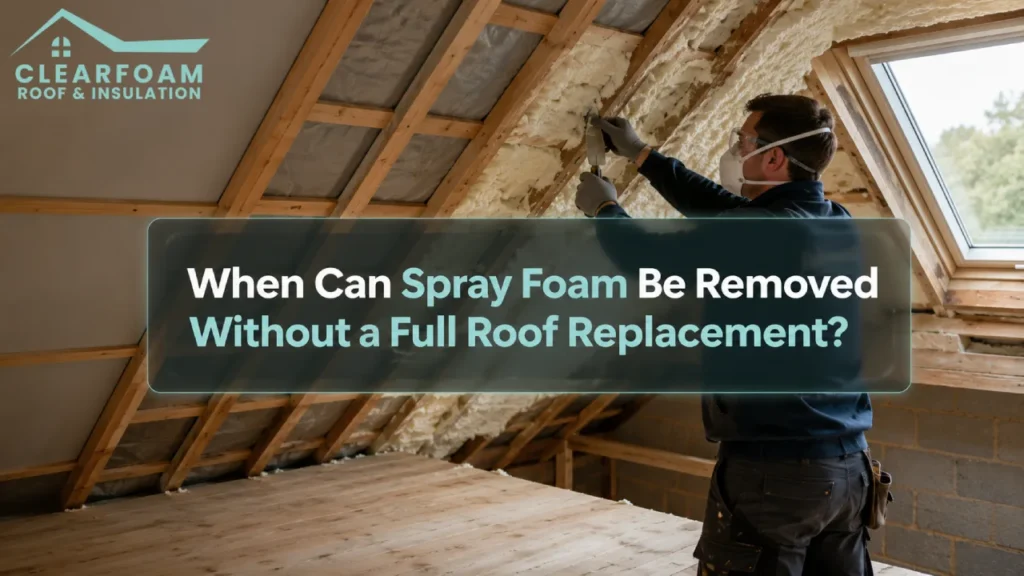
Spray foam removal without roof replacement is sometimes possible, but the answer depends on the roof beneath the insulation. The key questions are where the foam was applied, how strongly it has bonded, and whether the rafters, underlay, battens and roof covering remain serviceable once the material is taken away.
ClearFoam Roof & Insulation works with homeowners in Bournemouth and surrounding Dorset areas who need the foam and roof condition assessed together. A full reroof should not be assumed at the start, but keeping the existing roof cannot be guaranteed before enough of the structure has been exposed.
Start With the Part of the Roof the Foam Touches
The location of the foam often has more influence on the outcome than the foam type alone. Material applied between accessible rafters may leave more scope for internal removal than foam sprayed continuously across timber, felt and the back of the roof covering.
| Foam Location | What It May Mean for Removal | Main Risk to Check |
| On Accessible Rafters | Timber may be exposed gradually from inside the loft | Residue, hidden moisture and surface damage |
| Bonded to Roofing Felt | Separation may tear older or fragile underlay | Loss of weather protection |
| Across Battens | Removal may disturb fixings or concealed timber | Wider access may be needed |
| Directly on Tiles or Slates | Individual coverings may be difficult to inspect or replace | Roof covering may already rely on the foam |
| Around Joints and Fixings | Foam may be difficult to remove cleanly | Local damage can spread during extraction |
A pre-removal survey should record where the material sits, whether test areas can be opened and which roof components may be vulnerable. Homeowners can review spray foam removal when the insulation and roof need to be considered as one project.
Four Outcomes Are Possible After Removal Begins
The result is not always a choice between doing nothing and replacing the whole roof. Once the foam is removed, the property may fall into one of four broad outcomes:
1. The Existing Roof Can Remain:
The timbers, underlay and covering are serviceable, with no meaningful damage found.
2. Targeted Repairs Are Enough:
A few rafters, membrane sections, tiles or ventilation details need local work.
3. Part of the Roof Needs Opening:
One area may require the covering and battens to be lifted so concealed damage can be repaired properly.
4. A Full Reroof Is Justified:
Widespread decay, failed underlay, damaged battens or an ageing roof covering make isolated repairs impractical.
This is why spray foam removal without roof replacement should be treated as a property-specific outcome, not a promise made before the roof is exposed.
Bond Strength Matters More Than a Simple Foam Label
Open-cell foam is usually softer and less dense, while closed-cell foam is firmer and often more resistant to separation. Those descriptions are useful, but they do not tell you whether the roof can be retained.
Open-Cell Foam
Open-cell material may cut away more readily in some lofts. It can still cling to timber grain, fixings and fragile underlay, especially where it was applied thickly or pushed into narrow roof details.
Closed-Cell Foam
Closed-cell material may form a stronger, more rigid bond. Removal can place more stress on felt, membrane or timber surfaces, but it does not automatically mean the roof must be replaced.
The installer should judge the actual bond, access and substrate rather than relying only on whether the foam is open-cell or closed-cell.
Hidden Damage Can Change the Plan Midway
A roof may look acceptable around the edges of the foam while concealing moisture staining, soft timber or damaged underlay underneath it. The true condition may only become clear as each section is exposed.
A sensible work plan allows for review points. If removal reveals wet rot, cracked rafters or extensive membrane damage, the homeowner should be shown the evidence before the scope changes.
Spray foam removal without roof replacement remains realistic only when the retained components can continue to perform after any repairs are finished. A roof that was already failing before the foam was installed may need more work than the insulation alone would suggest.
Local Repairs Can Keep a Serviceable Roof in Use
Limited damage does not always justify replacing an otherwise sound roof. Local timber repairs, isolated membrane work, replacement tiles or improved ventilation may be enough when defects are confined to specific areas.
A rafter with one damaged section may be suitable for repair or splicing, subject to professional assessment. Small underlay defects may also have a practical solution if the area can be reached and the surrounding material remains sound.
Where the choice is not clear, the guide to roof repair or replacement explains why one local defect and widespread roof deterioration should be treated differently.
Signs That Wider Roof Work May Be Unavoidable
Full replacement becomes more likely when the foam has bonded large parts of the roof build-up together or removal repeatedly damages the underlay, battens or covering.
Widespread fungal decay, sagging timbers, softened rafters, failed battens and extensive water staining can also move the decision away from local repair. The same applies where the roof covering was already close to the end of its serviceable life.
Spray foam removal without roof replacement may no longer be practical when several roof components need renewal across most of a pitch. In that situation, opening the roof can be the only reliable way to replace the underlay, battens and damaged structural elements.
What Should Be Recorded Before and After the Work?
Good documentation helps a roofer, surveyor or future valuer understand what was removed and what condition was found. It should describe facts rather than promise a particular mortgage or sale outcome.
Useful records may include:
- Initial Photographs: Images showing foam coverage, visible staining, ventilation and accessible roof defects.
- Test Area Findings: Notes on adhesion, residue and the condition of the surface beneath.
- Progress Photographs: Evidence of the roof structure as removal continues.
- Timber Observations: Details of staining, decay, cracks or repairs.
- Moisture Readings: Results where suitable readings have been taken and recorded correctly.
- Repair Information: A clear description of any timber, membrane, tile or ventilation work.
- Completion Evidence: Photographs of the exposed and cleaned roof structure after the work.
A removal certificate alone does not guarantee that a lender will accept the property. Lending decisions remain with the lender and its surveyor or valuer.
Who Should Judge the Final Roof Condition?
Different professionals answer different questions. A spray foam contractor can assess access and removal, while a roofing contractor is better placed to judge tiles, slates, battens, underlay and weatherproofing.
A structural engineer may be needed where rafters, trusses, movement or significant decay raise questions about structural integrity. An independent surveyor may also help when the homeowner needs advice separate from the company carrying out the work.
ClearFoam Roof & Insulation provides roofing and insulation support in Dorset for homeowners in Bournemouth, Poole, Christchurch and nearby areas who need the foam, roof covering and visible structure assessed together.
Questions Homeowners Ask Before Keeping the Existing Roof
Can Spray Foam Be Removed Without Taking Off the Roof Tiles?
Sometimes. Internal removal may be possible when the foam is accessible and can be separated without damaging the underlay or roof covering.
Does Open-Cell Foam Usually Come Away More Easily?
It is often softer and easier to cut, but this does not guarantee straightforward removal. Open-cell foam can still bond tightly to felt, timber grain and fixings.
Does Closed-Cell Foam Mean I Need a New Roof?
No. Closed-cell foam can be harder to separate, but the need for replacement depends on the bond, the surfaces beneath it and the condition exposed during removal.
Can Damaged Rafters Be Repaired Instead of Replacing the Roof?
Local repairs may be possible where the damage is limited and the remaining structure is sound. Widespread decay or movement may require more extensive work.
Can Roofing Felt Be Repaired from Inside the Loft?
Some isolated defects may be reachable, but widespread underlay damage is difficult to renew properly from below. The roof covering and battens may need to be lifted.
Does Spray Foam Removal Damage the Roof?
Removal can damage felt, membranes, timber surfaces or roof coverings if the foam is strongly bonded. The method should be chosen around the actual roof build-up.
Does Spray Foam Removal Without Roof Replacement Guarantee Mortgage Approval?
No. Removal evidence and roof reports may help a valuer understand the property, but the lender makes its own decision.
Can New Loft Insulation Be Installed Afterwards?
Yes, once the roof is dry, any defects have been dealt with and the ventilation arrangement is understood. The replacement insulation should suit the roof design.
Make the Final Decision After the Structure Is Visible
Spray foam removal without roof replacement can work when the foam separates cleanly and the roof beneath remains serviceable or needs only limited repairs. A wider reroof may be justified when removal exposes extensive decay, failed underlay, damaged battens or a roof covering that can no longer be retained reliably.
ClearFoam Roof & Insulation can assess spray foam, visible roof components and practical removal options for homeowners across Bournemouth, Poole, Christchurch and surrounding Dorset. Keep clear records throughout the work and use the independent RICS guidance when discussing documentation, roof condition or a property transaction.