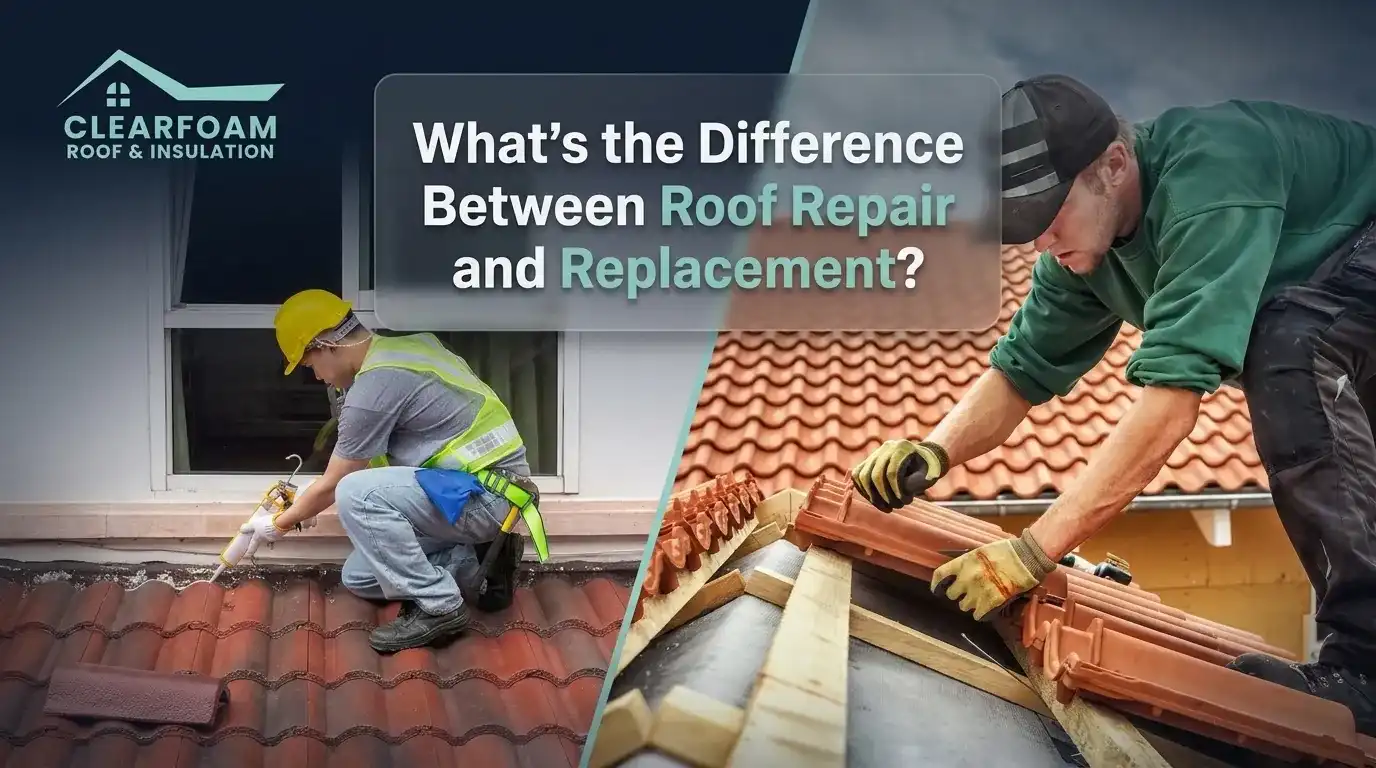

A homeowner in Bournemouth called us last autumn after Storm Aiden lifted six tiles off the gable end of a 1960s semi. The neighbouring roofer quoted a full replacement. Our inspection showed sound battens, healthy underlay, and no rot. Six new concrete interlocking tiles and an afternoon’s work fixed it.
That’s the heart of the roof repair vs replacement decision. Most roofs that look bad from the ground are not actually beyond saving. This guide helps UK homeowners across Dorset, Hampshire, and the South of England judge the difference accurately before signing off on work that costs far more than it should.
What’s the Real Difference Between Roof Repair and Replacement?
A roof repair fixes a specific defect like slipped tiles, failed flashing, or a localised leak while leaving the rest of the roof intact. A roof replacement strips and renews the entire covering, including tiles, battens, underlay, and sometimes the timber rafters themselves. The right call depends on damage location, material age, and the condition of the structure beneath.
The roof repair vs replacement decision is rarely about visible damage alone. What sits beneath the surface matters more than what you can see from the garden.
When Repair Is Enough
- Damage is localised to one area or a few tiles.
- The underlay and battens are still sound.
- Materials have years of expected lifespan left.
- Leaks are traceable to a single failure point.
When Replacement Becomes Necessary
- Multiple leaks across different areas.
- Underlay has perished across large sections.
- Timber rot is visible in rafters or battens.
- The roof has reached the end of its material lifespan.
When a full strip becomes the right call, our roof replacement services cover everything from pitched to flat roofs across the South.
How Much Roof Damage Requires Full Replacement?
Full replacement is usually required when more than 30% of the roof covering is damaged, when the underlay has perished, or when timber rafters show signs of rot. Below this threshold, targeted repairs almost always offer better value than tearing off the entire roof.
The roof repair vs replacement threshold isn’t a fixed percentage. It depends on what type of damage you have and where it sits.
Damage Patterns That Force Replacement
- Sagging ridges or bowed rafters.
- Multiple leaks in different sections.
- Widespread timber decay.
- Failed underlay across large areas.
- Tiles delaminating across a whole pitch.
Damage Patterns That Don’t
- Slipped or cracked tiles in one area.
- Failed flashing at chimneys or valleys.
- Damaged ridge mortar.
- A single penetration leak.
How Do I Know If My Roof Needs Replacement?
You know your roof needs replacement when you see widespread daylight through the underlay, sagging ridges, repeated leaks in different rooms, granules collecting in gutters from felt roofs, or rot in rafters visible from the loft. One of these alone justifies an inspection. Two or more usually mean replacement is the smarter spend.
Loft Inspection Checklist
A quick loft check tells you most of what you need to know:
- Daylight visible through the underlay.
- Water stains on rafters or insulation.
- Mould or musty smell.
- Sagging between rafters.
- Crumbling underlay when touched.
External Inspection Checklist
From ground level using binoculars:
- Missing, cracked, or slipped tiles.
- Sagging or dipping ridges.
- Moss or vegetation growing thickly.
- Lead flashing lifted or split.
- Daylight visible at the eaves.
Why a Professional Inspection Matters
DIY checks catch obvious problems. They miss hidden issues like delaminated underlay, compromised battens, and weakening rafter fixings. A professional roofer or RICS surveyor using a drone roof survey can see what ground inspection cannot.
How to Spot Roof Damage After a Storm?
After a UK storm, check for missing tiles, lifted ridge tiles, damaged flashing around chimneys, displaced lead valleys, blocked gutters with debris, and any internal water marks appearing within 24 to 48 hours. Document everything with photos before calling your insurer or roofer.
Storm Damage Categories
Category 1 (Light damage):
- Loose or slipped tiles.
- Minor flashing displacement.
- Vegetation in gutters.
Category 2 (Moderate damage):
- Multiple missing tiles.
- Ridge tiles displaced.
- Flashing torn.
Category 3 (Severe damage):
- Sections of covering blown off.
- Structural movement visible.
- Multiple internal leaks.
Insurance Claim Considerations
Most UK buildings insurance covers storm damage where wind speeds exceed 55mph. Keep records of damage with timestamped photos, check the Met Office storm records for the storm in question, and get a written quote from an NFRC registered roofer before authorising work.
The roof repair vs replacement decision after a storm often shifts in favour of replacement only when insurers identify hidden damage during the claim assessment.
How Often Should a Roof Be Inspected?
A UK roof should be inspected professionally every two to three years for properties under 20 years old, annually for older properties, and immediately after any major storm. Annual visual checks from the homeowner catch most issues early enough to keep the roof repair vs replacement decision firmly in repair territory.
Recommended Inspection Frequency
- Newer roofs (under 20 years): Every 2 to 3 years
- Older roofs (20 to 40 years): Annually
- Aged roofs (40+ years): Twice yearly
- After storms with wind above 55mph: Immediate
- Before selling: Always
What a Professional Inspection Covers
A proper roof inspection covers tile condition, underlay integrity, flashing at chimneys and abutments, lead work in valleys, ridge and hip mortar, gutter function, fascia and soffit condition, and the state of rafters and battens from the loft side.
Increasingly, roofers use drone surveys to inspect roofs safely without scaffolding, particularly useful for pitched roofs above two storeys.
What’s the Average Roof Lifespan by Material?
UK roof lifespans vary by material: concrete interlocking tiles last 50 to 60 years, clay tiles 60 to 100 years, natural slate 80 to 150 years, felt flat roofs 10 to 20 years, EPDM rubber 30 to 50 years, and GRP fibreglass 25 to 30 years. Knowing your roof’s age relative to its material lifespan tips the roof repair vs replacement decision decisively.
Pitched Roof Material Lifespans
- Concrete interlocking tiles: 50 to 60 years
- Clay plain tiles: 60 to 100 years
- Natural Welsh slate: 80 to 150 years
- Spanish slate: 50 to 100 years
- Reconstituted slate: 30 to 50 years
Flat Roof Material Lifespans
- Three-layer felt: 10 to 20 years
- EPDM rubber: 30 to 50 years
- GRP fibreglass: 25 to 30 years
- Single-ply membrane: 20 to 30 years
- Liquid applied systems: 15 to 25 years
A roof in the final quarter of its material life rarely justifies major repairs. Better to plan replacement on your timeline rather than after the next storm.
How Does Spray Foam Affect the Repair or Replacement Decision?
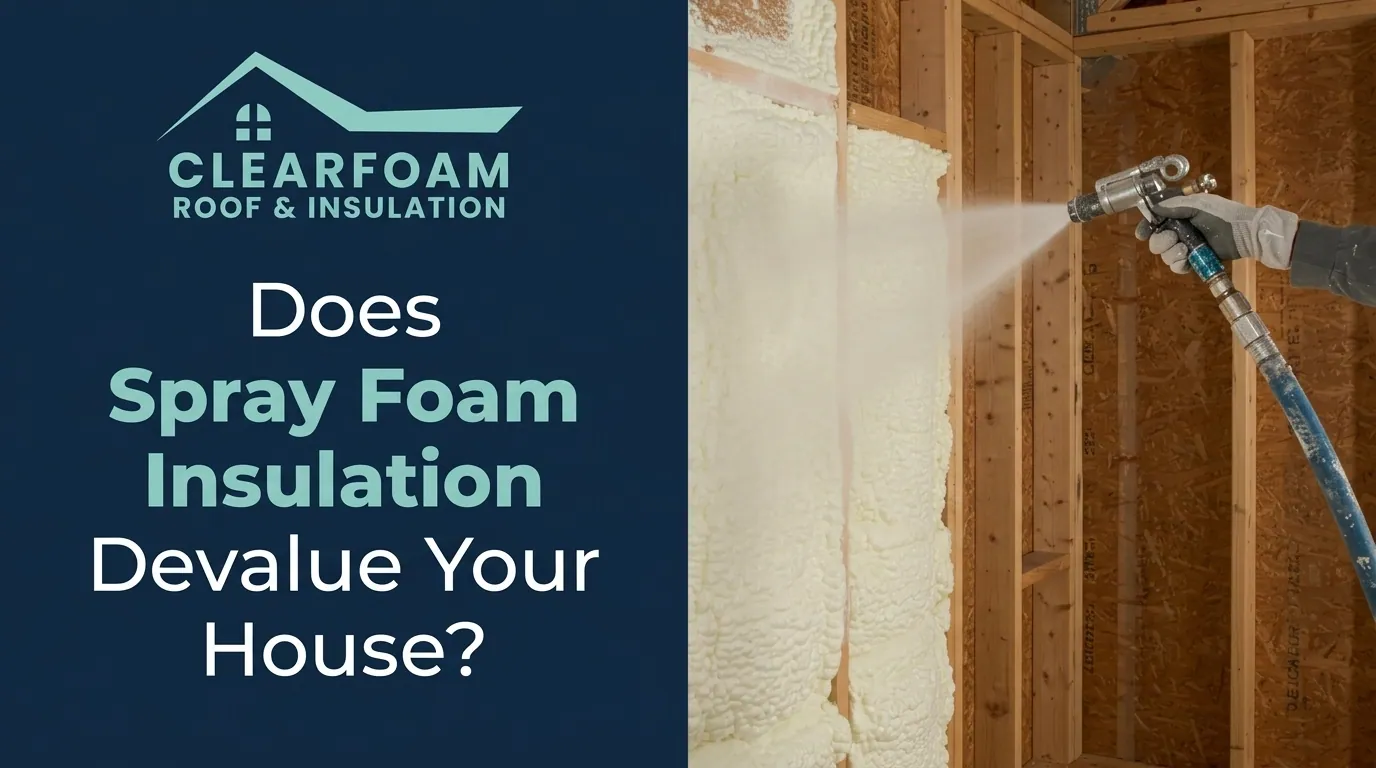
Spray foam insulation applied to the underside of a UK roof almost always shifts the decision toward replacement rather than repair. The foam hides defects from inspection, traps moisture against timber rafters causing rot, and routinely blocks mortgage approval through RICS Home Survey Level 2 and Level 3 reports.
Why Spray Foam Forces Replacement
- Hidden defects cannot be inspected through foam.
- Moisture traps form between foam and underlay.
- Timber rot develops without visible warning signs.
- Mortgage lenders routinely refuse properties with spray foam.
- RICS surveyors flag spray foam as a defect on inspection.
If your roof has spray foam and you’re weighing roof repair vs replacement, the answer is usually: remove the foam first, then decide. We’ve seen properties in Bournemouth, Poole, and Christchurch where removing foam revealed perfectly sound roofs that needed no replacement at all.
Building Regulations and Compliance Considerations
Major roof replacements in the UK must meet current Building Regulations, primarily Part L for thermal performance, Part F for ventilation, and Part B for fire safety. Repairs under 25% of the roof area usually fall outside notification requirements. Replacements always need either Building Control approval or installation by a competent person registered with NFRC or Competent Roofer.
Key Standards That Apply
- BS 5534 (Code of practice for slating and tiling).
- BS 8217 (Reinforced bitumen membranes for roofing).
- Part L of Building Regulations (thermal performance).
- Part F of Building Regulations (ventilation).
- HSE Working at Height Regulations 2005.
Using a roofer registered with NFRC or Competent Roofer means the work is self-certified for compliance without requiring separate Building Control sign-off.
Making the Right Roof Repair vs Replacement Decision
Most UK roofs we inspect can be repaired. The exceptions are roofs nearing the end of their material lifespan, those with widespread underlay failure, properties with structural movement, and homes affected by spray foam insulation hiding underlying problems.
If your roof is showing problems, get a proper inspection before agreeing to either option. ClearFoam Roof & Insulation provides honest assessments across Bournemouth, Poole, Christchurch, Southampton, and the wider South of England. Call us or book a roof inspection for a same-week site visit.
Common Questions About Roof Repair vs Replacement Answered
Is Roof Repair Cheaper Than Replacement in the UK?
Yes, roof repair is almost always cheaper than replacement in the short term. The roof repair vs replacement question changes over time though, since repeated repairs on an aging roof can cost more than one well-timed replacement. A good roofer will tell you when you’ve crossed that threshold rather than keep selling repairs.
Can You Partially Replace A UK Roof?
Yes, partial replacement of a single roof slope or section is possible and often sensible when one elevation has failed while others remain sound. Match the new tiles or slates carefully to the existing covering, and ensure underlay and battens are renewed together to avoid mismatched lifespans.
Does Roof Replacement Need Planning Permission in the UK?
A like-for-like roof replacement usually falls under permitted development and needs no planning permission. Changes that alter the roof’s height, shape, or appearance, especially in conservation areas or on listed buildings, will require approval from your local planning authority before work starts.
Will Home Insurance Pay for Roof Replacement?
UK home insurance covers roof replacement only where damage results from an insured event such as storm damage, fire, or impact. Wear and tear, age-related failure, and poor maintenance are not covered. Get a written NFRC registered roofer’s report supporting the claim before authorising work.
How Long Does a Roof Replacement Take in the UK?
A typical UK semi-detached roof replacement takes three to five working days in good weather. Larger detached properties may take a week or more. Weather delays, scaffolding access, and unforeseen timber rot discovered during stripping can extend the timeline. Get the timeframe in writing before work starts.