Most homeowners treat their attic like a giant plywood jigsaw puzzle that just needs to be screwed down. I have seen this expensive mistake lead to crushed mineral wool and a literal breeding ground for interstitial condensation that eventually rots the rafters. At ClearFoam Roof & Insulation we have learned that learning how to board a loft with insulation is not just about creating floor space but about preserving the air gap your house needs to breathe.
If you are looking for a permanent storage solution you must understand that the timber joists are only the start of the framework. The real battle happens in the cavity where the thermal bridge remains active and can even cause damp spots through cold bridging that ruin your ceiling. This creates a structural hazard and a pocket of trapped moisture that can invite black mold into your healthy living environment.
Why Compressing Glass Wool Is Often a Homeowner Fantasy
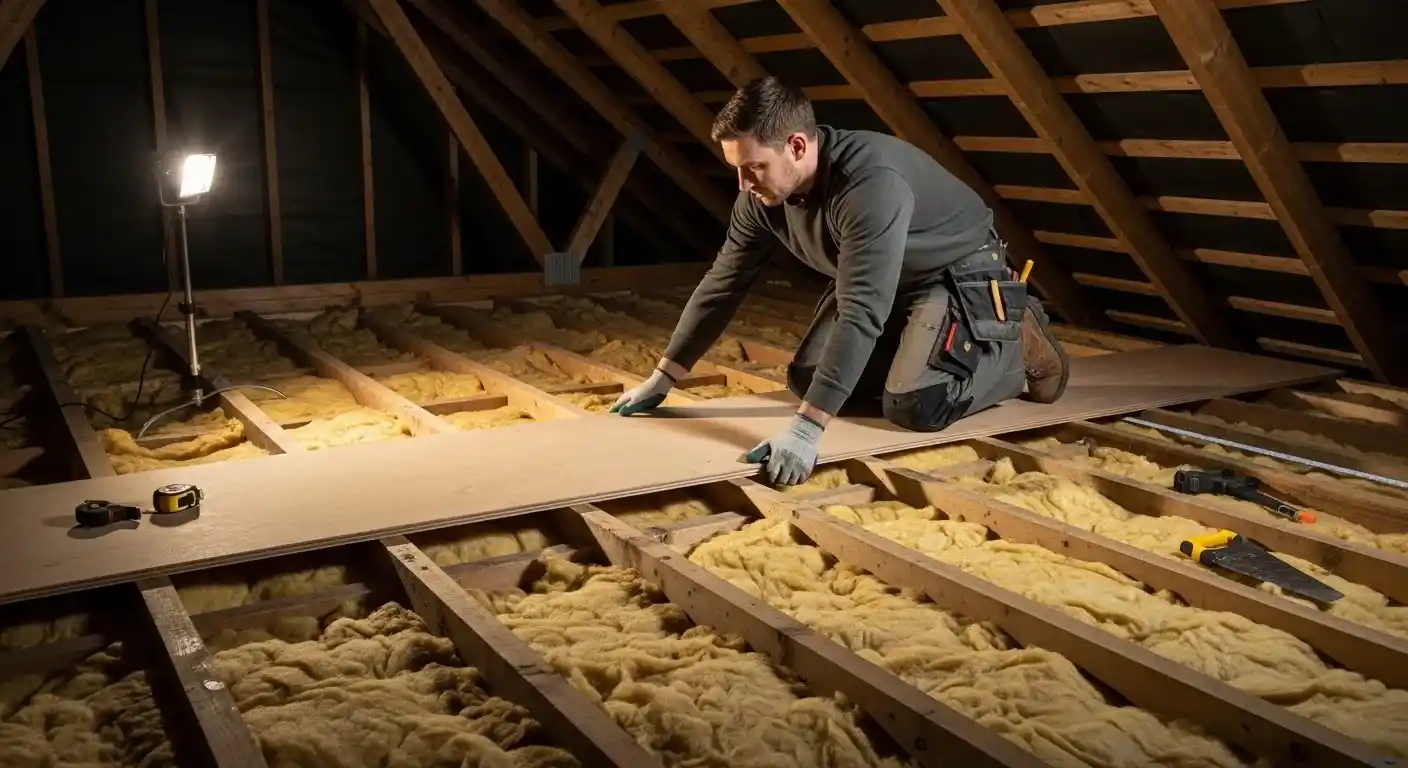
Many people think squashing six inches of fluffy material under a heavy board will make the floor more stable. In my experience this is the most common blunder in energy maintenance because insulation works by trapping air in its fibers. When you focus on how to board a loft with insulation using direct screw methods you are essentially killing the R-value of the product and wasting your heating budget.
The most effective approach involves raising the floor level to allow for a full depth of fill without any pressure. At ClearFoam Roof & Insulation we recommend using specialized loft legs or a cross batten system to encourage a continuous thermal blanket. If you rush this process you will end up with a stubborn condensation problem that refuses to vanish even after you install extra roof vents.
Three Practical Methods for Level Loft Flooring
Installing Raised Loft Leg Systems
If your joists are only four inches deep you can often win the fight with a set of plastic loft stilts. You must space them consistently to ensure the weight of your storage boxes does not bow the plasterboard below.
The Power of Cross Battening
For larger challenges where height is not an issue a secondary layer of timber at right angles is the undisputed king of durability. This method is the favorite at ClearFoam Roof & Insulation because it provides a massive amount of structural strength while leaving a clear path for electrical cables.
Managing Ventilation Pathways
You can use eaves vents and baffles to manage the airflow while keeping the boards away from the roof edges. This method is highly effective but requires a timeframe of a few hours to ensure the soffit vents remain unobstructed and clear.
Avoiding Thermal Bypass
Gaps between the boards are a traditional oversight that works poorly if the wind is whistling through the tiles. You must use a tongue and groove system to maintain a tight seal that reaches deep into the insulation layer to ensure heat does not escape.
Why Keeping Your Attic Airy Is More Important Than Extra Space
When you evaluate how to board a loft with insulation the primary factor should always be the health of the roof timbers. If you plan to store heavy suitcases over old glass fiber or sheep wool you cannot afford to have a restricted air path shifting the dew point into your wood. A professional application removes the risk of dry rot and leaves behind a functional space that actually improves your energy performance certificate and home value over time.
Proper loft insulation and ventilation also play a major role in maintaining energy efficiency throughout the home. According to guidance from the Energy Saving Trust Roof and Loft Insulation Advice installing and maintaining loft insulation correctly can significantly reduce heat loss while helping prevent moisture problems in roof spaces.
I have witnessed homeowners spend weeks hammering only to realize they lack the clearance to move around the water tank. Choosing a professional path with ClearFoam Roof & Insulation saves your knees and ensures the ugly damp patches are prevented before the next winter arrives. It is the only way to guarantee a level surface that looks like the loft was designed for storage from day one.
Critical Gear for Safe Attic Reclamation
If you decide to take on a DIY project you will need a specific kit to ensure success. Proper preparation is the difference between a successful weekend and a devastating month of dealing with itchy skin and dusty lungs.
- A heavy-duty cordless impact driver for achieving a secure mechanical fix without splitting the wood.
- A sharp handsaw for trimming boards around the chimney stack and prying them into tight corners.
- Protective respirators and disposable coveralls to guard against glass fibers and ancient dust.
- High quality PIR insulation or rock wool batts to initiate the heat retention.
At ClearFoam Roof & Insulation we always suggest clearing a four-foot radius around the hatch to avoid hitting hidden pipes or lighting circuits. Once the joists are exposed you can accurately judge if you have the right tools for the job or if you need to call in a specialist. This is often the most efficient way to manage how to board a loft with insulation without ruining your home insulation efficiency.
Related Article: How Fast Does Loft Insulation Make Your House Warmer
How to Stop Moisture and Rot from Ruining Your Roof
Attacking the Problem of Crushed Fibers
The air to wool ratio is often the hardest part to maintain but it must be perfect to stop all future heat loss.
Controlling Internal Vapor Movement
Some houses like older bungalows have poor vapor barriers which can damage nearby purlins.
Working in Cramped Dark Spaces
Trying to balance on joists in a dark attic is a recipe for disaster because the lack of light makes it nearly impossible to work safely.
Smart Strategies for Cable Management
You will likely end up with more wires than you expect so plan for a conduit box.
Maintaining Ecological Balance Under the Tiles
Adding boards is not just a storage change because it shifts the temperature of your roof space in ways that can be detrimental to the structure. As the heat is trapped below the boards it can pull moisture out of the air which leads to silverfish and weakened timbers. I have seen beautiful homes ruined because a fresh floor was allowed to be installed without any thought for the surrounding roof pitch.
By focusing on how to board a loft with insulation now you are protecting the long-term integrity of your entire building. At ClearFoam Roof & Insulation we believe in proactive measures that remove fire risks before they can jump to your stored memories or festive decorations. A dry loft is a healthy loft and fixing the errors of a poorly insulated floor is the final step in that journey.
Frequently Asked Questions
What Is the Quickest Way to Create Storage Without Losing Heat?
If you cannot install a full timber frame then plastic loft legs are your only real choice but they are not a five-minute fix. I tell my clients to measure twice and use a laser level. It still takes time for the boards to sit perfectly flat but it is better than a wobbly floor that damages your ceiling.
Will The Boards Cause Damp If I Leave Them in Place?
Yes, especially in houses that experience high humidity levels from bathrooms or kitchens. If you do not tackle the airflow issue you will be replacing moldy suitcases every single year. This is why learning how to board a loft with insulation is so vital for a clean and dry home.
Is It Safe to Use Standard Chipboard for the Floor?
It is risky because chipboard can swell and fail if there is any leak or significant damp. I have seen floors buckle and snap within a single season. If you do use it you need to monitor it constantly and ensure the air stays circulating across the entire surface of the board.
Can I Just Put Boards Directly on The Joists?
I strongly advise against this because the joists are rarely deep enough to hold modern levels of insulation. You will end up with a cold house and a high energy bill. Plus, the compressed wool will pull the warmth right out of your bedrooms.
Why Do Professional Installers Prefer Raised Flooring Systems?
Putting a massive amount of weight on the ceiling joists in one go can cause massive collateral damage to your decoration. Raised systems are surgical. At ClearFoam Roof & Insulation we can create a storage platform without disturbing the delicate insulation layers just an inch away.