Streaming windows, black mould patches in the corner of the bedroom, that musty smell that won’t shift. Condensation damages UK homes every year through ruined plaster, rotting timber, and serious respiratory health risks. The question is whether spray foam insulation actually solves it, or quietly makes it worse.
The honest answer depends on which type of foam you choose, who installs it, and what your home needs in the first place.
Does Spray Foam Stop Condensation?
Yes, properly installed closed-cell spray foam insulation stops condensation in most UK homes by sealing air leaks, eliminating cold surfaces where moisture forms, and acting as a vapour barrier. However, the wrong foam type or a poor installation can trap moisture and make condensation problems significantly worse.
Three things determine the outcome:
| Factor | Stops Condensation | Causes Condensation |
| Foam type | Closed-cell on cold surfaces | Open-cell in unventilated lofts |
| Installation | Certified installer, full survey | Untrained applicator, no assessment |
| Ventilation | MVHR or trickle vents added | Property sealed with no airflow plan |
| Surveys | Pre-install moisture check | Foam sprayed over existing damp |
The British Board of Agrément (BBA) and KIWA both certify spray foam systems that meet UK building standards. If your installer can’t show you certification numbers, walk away.
How Does Condensation Actually Form in UK Homes?
Condensation happens when warm, moisture-laden air meets a cold surface and the water vapour turns to liquid. The temperature at which this happens is called the dew point. Inside a typical UK home, indoor air carries moisture from cooking, showering, breathing, and drying laundry, around 4 to 12 litres of water per day for a family of four.
When that humid air drifts to a cold spot, the wall behind a wardrobe, the underside of a roof, the inside of a single-glazed window, the moisture drops out as droplets. Over weeks and months, those droplets feed black mould (Aspergillus niger and Stachybotrys chartarum), rot timber, and damage plaster. The fix isn’t just adding heat or ventilation alone. It’s eliminating the cold surfaces entirely, which is where insulation strategy becomes critical.
Open-Cell vs Closed-Cell: Which Spray Foam Stops Condensation?
This is where most UK homeowners get the wrong advice. The two types behave completely differently when it comes to moisture.
Closed-cell spray foam:
- Density of 30 to 50 kg/m³
- Acts as a vapour barrier (impermeable to moisture)
- R-value around 6.0 to 7.0 per inch
- Adds structural rigidity to walls and roofs
- Best for: solid walls, basements, flat roofs, vans, cold pitched roofs
Open-cell spray foam:
- Density of 7 to 12 kg/m³
- Allows moisture vapour to pass through
- R-value around 3.5 to 4.0 per inch
- Softer, more flexible
- Best for: internal walls, ceilings between heated rooms, soundproofing
For stopping condensation in cold, humid UK conditions, closed-cell foam is the right answer in 90% of cases. ClearFoam only installs systems that match the specific moisture and thermal demands of your property, confirmed through a pre-installation survey.
The UK Mortgage Issue You Need to Know About
You’ve probably read the horror stories. Homeowners across the UK have struggled to sell their properties or remortgage after having spray foam installed in the loft, with some lenders refusing to lend at all. This isn’t a rare occurrence anymore.
Here’s the reality. Many UK lenders, including Nationwide, Halifax, and several building societies, now refuse mortgages on properties with non-certified spray foam in the loft. The concern isn’t the foam itself. It’s that uncertified installations can hide structural problems, prevent proper roof inspection, and trap moisture against timber. The Property Care Association (PCA) and RICS have both issued guidance flagging poorly installed foam as a valuation risk.
The way around this is straightforward. Choose an installer registered with TrustMark and PAS 2030 certified, using BBA-approved or KIWA-approved foam systems. Get full documentation including the installer’s certification, the foam’s certification number, the survey report, and a long-term product guarantee. Properties with this paperwork pass mortgage valuations without issue.
When Spray Foam Causes Condensation Instead of Stopping It
Spray foam isn’t a magic solution. There are specific scenarios where it makes problems worse, and an honest installer will tell you upfront.
Watch out for these situations:
- Roof timbers already damp: Spraying foam over wet wood traps moisture and accelerates rot
- No ventilation strategy: Sealing the building envelope without adding mechanical ventilation (MVHR) raises indoor humidity
- Open-cell foam in cold lofts: Allows warm moist air to reach cold roof tiles and condense
- Spraying directly to cold sheathing: Without correct thickness, condensation forms at the dew point inside the foam
- Skipping the survey: Existing structural defects, leaks, or rising damp need fixing first
- Cheap, uncertified foam: Doesn’t meet BBA standards and shrinks over time, creating air gaps
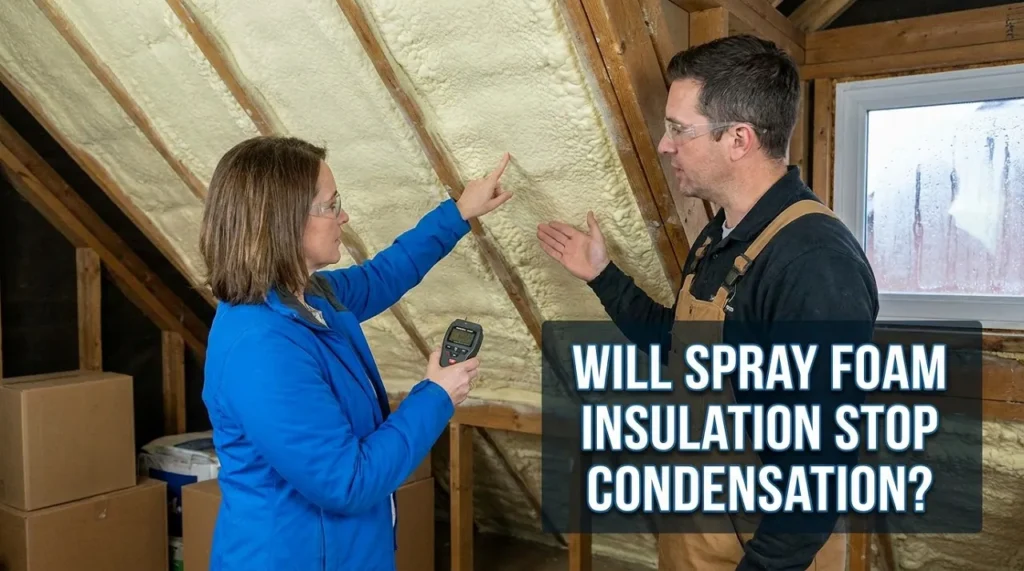
A proper UK installer will conduct a moisture meter survey, check for active leaks, assess ventilation, and recommend MVHR or trickle vents where needed. ClearFoam refuses jobs where these conditions can’t be met. It’s the only way the work delivers what it promises.
What Should You Look For in a UK Spray Foam Installer?
Choosing the right installer matters more than the foam itself. Even premium products fail when applied badly, and the UK has seen a wave of cowboy operators damaging both homes and the industry’s reputation.
Before you sign anything, check the installer for:
- TrustMark registration: The government-endorsed quality scheme for tradespeople
- PAS 2030 certification: Required for energy efficiency installations in UK homes
- BBA or KIWA-approved foam: Verifiable certification numbers, not just brand claims
- Pre-installation survey: Conducted by a qualified surveyor, not a salesperson
- Written guarantee: Long-term product warranty plus workmanship cover
- Public liability insurance: Minimum £2 million cover for residential work
- Honest references: Recent customers in your area you can actually contact
ClearFoam ticks every box. We’ll happily provide certification numbers, survey reports, and recent customer references before you commit to anything.
Frequently Asked Questions About Spray Foam and Condensation
Will Spray Foam Insulation Cause Black Mould?
Properly installed closed-cell foam prevents the cold surfaces that black mould (Aspergillus and Stachybotrys species) needs to grow. Poorly installed foam without ventilation planning can raise humidity and create new mould risk. The install method matters more than the product itself.
Do I Need Ventilation After Spray Foam Insulation?
Yes, in most UK homes. Sealing the building envelope without ventilation traps cooking, washing, and breathing moisture inside. Mechanical Ventilation with Heat Recovery (MVHR) or positive input ventilation (PIV) systems are commonly recommended alongside foam installation in airtight homes.
Can Spray Foam Be Removed If It Causes Problems?
Removal is possible but difficult. The foam bonds permanently to roof timbers, and removal is mechanical, often damaging the substrate. This is why choosing the right installer the first time matters so much.
Is Spray Foam Insulation Safe for Older UK Properties?
It depends on the property. Solid stone walls, lime mortar buildings, and listed properties often need breathable insulation rather than spray foam. ClearFoam surveys every property individually and will recommend alternatives like mineral wool or wood fibre where foam isn’t suitable.
How Long Does Spray Foam Insulation Last?
Certified closed-cell spray foam from approved UK manufacturers typically lasts 30 to 80 years without degradation. Look for products with a strong manufacturer guarantee and BBA or KIWA certification numbers you can verify.